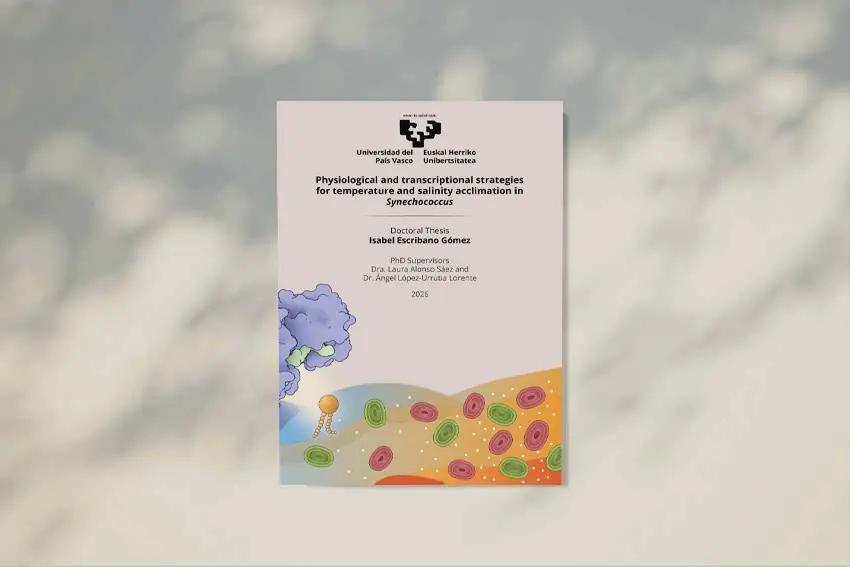
El pasado 15 de mayo Isabel Escribano defendió su tesis titulada «Physiological and transcriptional strategies for temperature and salinity acclimation in Synechococcus« en la Facultad de Ciencia y Tecnología de la Universidad del País Vasco (EHU).
La investigación se ha desarrollado en AZTI bajo la dirección de los doctores Laura Alonso (AZTI) y Ángel López-Urrutia Lorente (Instituto Español de Oceanografía) y ha obtenido la calificación de sobresaliente cum laude.
Marine cyanobacteria are the most abundant photosynthetic organisms on Earth, contributing approximately 25% of global net primary production. The two sister clades of marine cyanobacteria, Prochlorococcus and Synechococcus, exhibit distinct biogeographical patterns. While Prochlorococcus dominates open-ocean tropical and subtropical waters, Synechococcus exhibits a broader distribution that extends into higher latitude regions. Temperature is recognized as a key environmental driver shaping the distribution of picocyanobacteria, with specialized lineages adapted to distinct thermal niches. Along with temperature, salinity represents another critical factor that constrains both the physiology and spatial distribution of these microorganisms.
This thesis explores the physiological responses of marine cyanobacteria to the combined impact of temperature and salinity and the transcriptional basis underlying these responses.