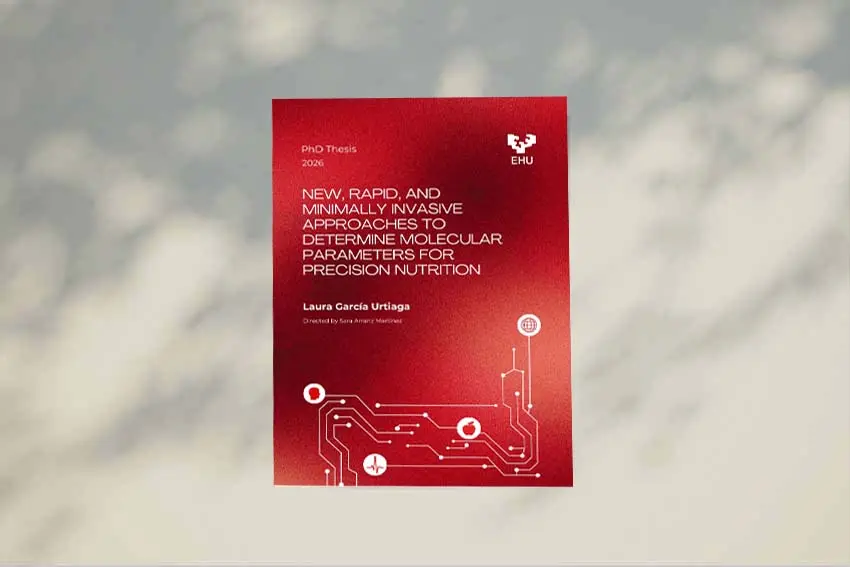
El pasado 17 de septiembre de 2026, Laura García Urtiaga, investigadora del área de Alimentación y Salud, defendió con éxito su tesis doctoral titulada “New, rapid, and minimally invasive approaches to determine molecular parameters for precision nutrition” en la Universidad del País Vasco (EHU).
La investigación se ha desarrollado en AZTI bajo la dirección de Sara Arranz , y se ha centrado en el diseño y validación de nuevas herramientas mínimamente invasivas para evaluar de forma objetiva la alimentación y el estado de salud cardiometabólico, combinando biomarcadores basados en lipidómica con tecnologías sensóricas no invasivas.
Los resultados de su trabajo suponen un importante avance hacia una nutrición personalizada más precisa, accesible y escalable, facilitando la monitorización de hábitos alimentarios y la identificación temprana de factores de riesgo cardiometabólico.
La tesis obtuvo la calificación de sobresaliente cum laude, con opción a premio extraordinario, y mención internacional.
Nutrition plays a fundamental role from the earliest stages of life in ensuring optimal health and a good quality of life. In recent years, the prevalence of non-communicable chronic diseases, which are closely linked to diet and lifestyle, has risen markedly worldwide, underscoring the need to address this challenge. To do so, it is essential to obtain accurate information on dietary intake; however, traditional methods present limitations that hinder the acquisition of precise data. This thesis explores novel, rapid, and non-invasive methodologies, including omics sciences, particularly lipidomics, and sensor-based technologies, with the aim of advancing personalised nutrition and improving the prevention of diet- and lifestyle-related diseases.
The findings of this thesis demonstrate that omics‑based biomarkers, particularly DBS‑derived fatty acids (FA), capture meaningful dietary patterns and offer objective alternatives to self‑reported intake. When combined with fully non‑invasive sensors, they contribute additional, physiologically relevant information for the early characterisation of cardiometabolic health. Owing to their speed, low burden and scalability, these methodologies can facilitate data collection across large populations and lay the groundwork for future precision nutrition strategies. Nonetheless, controlled studies in larger and more diverse cohorts are required to define biomarker ranges linked to specific dietary exposures and to validate their applicability in preventive healthcare.