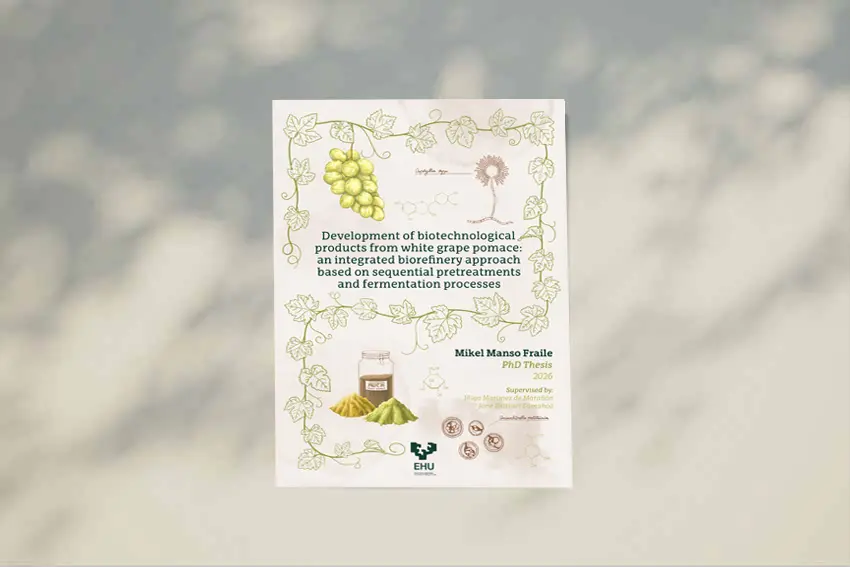
El pasado 15 de julio, Mikel Manso Fraile , del área de Procesos Eficientes y Sostenibles, defendió con éxito su tesis doctoral titulada Development of biotechnological products from white grape pomace: an integrated biorefinery approach based on sequential pretreatments and fermentation processes en la facultad de Farmacia de la Universidad del País Vasco (EHU).
La investigación ha sido desarrollada en AZTI, dirigida por los doctores Jone Ibarruri e Iñigo Martínez de Marañon y bajo la tutoría de directa de Marta Cebrián (todos de AZTI). La tesis fue defendida en inglés y euskera y obtuvo la calificación de Sobresaliente Cum Laude y las menciones de Doctorado Industrial y Doctorado Internacional.
The increasing generation of agro-industrial residues and the growing demand for sustainable sources of food and feed ingredients highlight the need for innovative valorisation strategies aligned with the principles of the circular bioeconomy. Among these residues, white grape pomace (WGP), a by-product of the wine industry consisting mainly of skins, seeds and residual pulp, represents a particularly promising feedstock due to its richness in structural carbohydrates, phenolic compounds, lipids and residual sugars. However, its direct utilisation is limited by the recalcitrant lignocellulosic structure of the biomass and the presence of compounds that may reduce nutrient accessibility. Within this context, the present doctoral thesis was carried out at AZTI Research Centre with the aim of developing integrated biotechnological strategies for the valorisation of WGP through a cascade biorefinery approach capable of generating multiple value-added ingredients.
The research focused on the design and implementation of a multiproduct biorefinery combining pretreatment technologies, microbial fermentation processes and downstream processing operations. Three scientific articles derived from this work were published in international peer-reviewed journals, reflecting the relevance of the research outcomes within the fields of biotechnology, sustainable food systems and biomass valorisation.
Overall, the results of this thesis demonstrate that the integration of pretreatment technologies, microbial fermentation platforms and downstream processing strategies enables the comprehensive valorisation of WGP into multiple bio-based ingredients. The cascade biorefinery developed in this work provides a promising strategy for transforming winery by-products into valuable resources, contributing to the development of sustainable and circular bio-based production systems.