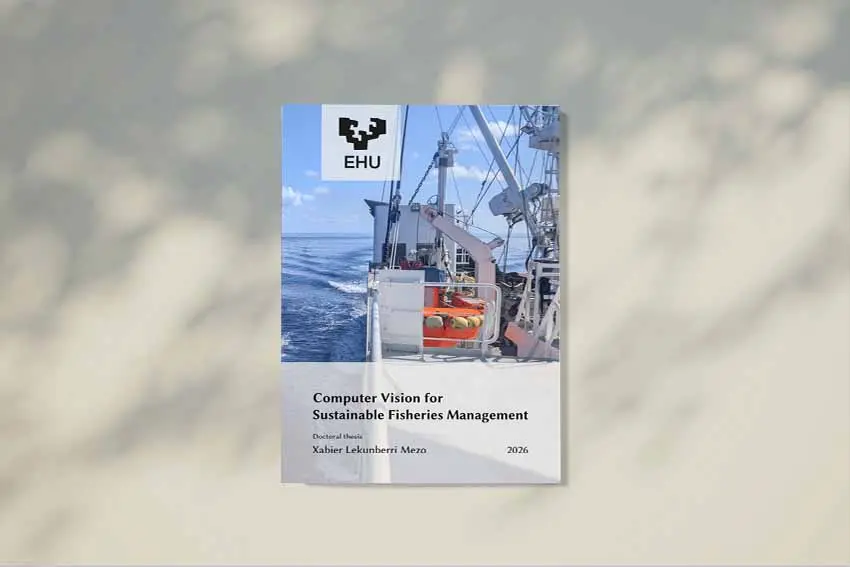
El pasado 27 de febrero Xabier Lekunberri Mezo defendió su tesis doctoral titulada: «Computer Vision for Sustainable Fisheries Management» en la facultad de Informática de la Universidad del País Vasco (EHU).
La investigación se ha desarrollado en AZTI, bajo la dirección de los doctores Josean Fernandes (AZTI) e Ignacio Arganda Carreras (EHU).
La tesis obtuvo la calificación de Sobresaliente Cum Laude.
Resources extracted from marine ecosystems are crucial to global food security and the economy. However, overfishing, habitat destruction, and other factors are creating increasing challenges. This thesis explores how deep learning and computer vision can enhance the monitoring and management of marine resources, focusing on the cases of the tropical tuna fishery and aquaculture farm mapping. It is framed within the context of growing regulatory pressure and sustainability requirements affecting the fishing industry, particularly in the European Union, where rigorous monitoring and control systems are mandatory.
The thesis explores how deep learning and computer vision can improve the monitoring and management of marine resources, with a focus on the tropical tuna fishery and aquaculture farm mapping. All developed models are validated and tested using real-world metrics to ensure applicability beyond controlled experimental settings. This thesis emphasizes the scalability and adaptability of these technologies across diverse regions and operational contexts. It recognizes the variability of marine ecosystems and fishing practices and highlights the transformative potential of these technologies for near-real-time monitoring.
This work advances sustainable fisheries and aquaculture management by integrating state-of-the-art computer vision models with practical monitoring needs and providing tools that support regulatory compliance, scientific research, and industry best practices. Ultimately, the goal is to promote transparency, efficiency, and ecological responsibility in the exploitation of marine resources.