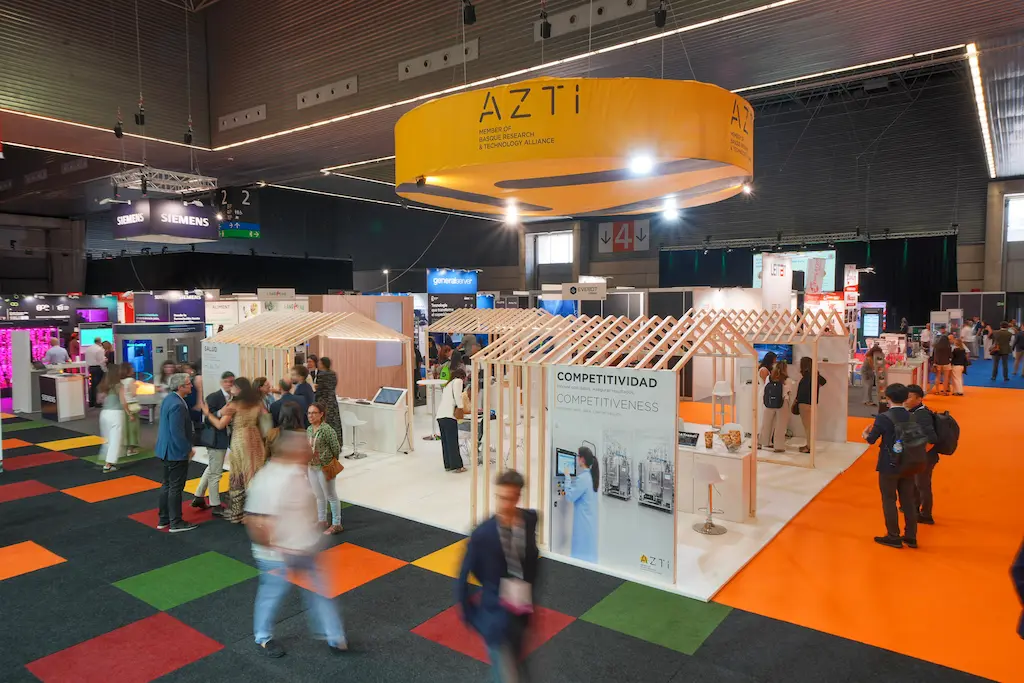
F4F – Expo Foodtech 2026 is much more than a trade show. On 27 and 28 May, the BEC – Bilbao Exhibition Centre will become the meeting point where the food industry shapes its future, bringing together more than 8,000 professionals in Bilbao to debate, learn and drive the sector’s transformation.
This year’s edition promises to be a transformative journey that will redefine the way we produce, process and distribute food. Automation, robotics, artificial intelligence, Industry 4.0 and machine vision systems are at the heart of a revolution that AZTI is helping to lead through science and applied innovation.
What You’ll Find at the AZTI Stand
Once again, at the AZTI stand (located in the main aisle), we will showcase solutions that are already delivering results in industry, addressing the four major challenges currently facing the food sector.
HEALTH: Designing Healthier Foods
Today’s consumers are looking for foods that support their wellbeing, meet specific needs and fit seamlessly into their daily lives. To deliver this, the industry must first understand what people actually eat and where nutritional gaps exist. AZTI has developed tools designed to do exactly that:
- AI-powered image recognition technology that identifies foods, estimates portion sizes and converts them into meaningful nutritional information, including energy values, macronutrients and key indicators. Over time, this will enable the creation of personalised nutritional profiles showing dietary patterns, deficiencies and progress.
- Foodata, a platform that integrates nutritional, regulatory and market criteria into product development from the outset. It calculates labelling requirements, assesses health claims and helps companies design products based on consumer needs.
- Real-world examples: YUIT (a solution for people with highly specific dietary needs such as dysphagia), Alakrana (tuna protein products designed for children) and Apex-Air Nuts (snacks with an improved nutritional profile produced using innovative processing technologies).
COMPETITIVENESS: Innovating Better, Not Just Faster
Many products fail not because they are poorly developed, but because they reach the market too late or because market conditions have changed by the time they launch. Competing more effectively starts with understanding where the market is truly heading and having more agile R&D processes with fewer risks and uncertainties.
- AZTI Consumer Observatory: combines over 20 years of official consumption data from the Spanish Ministry of Agriculture, Fisheries and Food (MAPA) with European studies from the EIT Food Consumer Observatory. It reveals what is happening and why, providing insights into consumption trends by product category, channel, region and consumer profile, as well as the motivations and barriers behind each trend.
- AZPilotManager: a digital platform that centralises formulation, ingredients, traceability and testing within a single system. It eliminates fragmented spreadsheets, automates key calculations (nutritional profiles, allergens and costs) and ensures full traceability from raw materials through to the final product.
- EATrends (AZTI Food Trends): combines scientific knowledge, consumer insight and close collaboration with industry to identify the forces shaping the future food system and support better-informed decision-making.
- Real-world examples: innovative products that stand out for their market-leading approaches.
SAFETY AND TRUST: Food Safety Beyond Control
Consumers want to know what they are buying, where it comes from and what guarantees stand behind it. A microbiological issue, food fraud incident or quality deviation is no longer merely a technical problem—it is a reputational and commercial risk. Yet many control systems remain slow and reactive. AZTI is working on a new model focused on anticipation rather than detection.
- Xpectra: a digital solution based on NIR technology that analyses product quality and composition without destroying the sample. Spectral data are captured directly on-site and analysed in the cloud, enabling immediate validation, customised model development and the early detection of deviations or potential fraud. No highly specialised expertise is required to interpret the results.
- Fagos: naturally occurring viruses that specifically infect targeted bacteria. They eliminate pathogens without affecting other microorganisms or the food itself, without the use of chemicals, and can be integrated with other control strategies. They can be applied at multiple stages of the food chain, from primary production and processing through to the final product.
SUSTAINABILITY: Producing More with Less
A significant proportion of the resources entering the food chain are not fully utilised. By-products are often treated as waste, generating management costs and losing valuable opportunities. The challenge is no longer simply to produce more, but to produce better within a circular model where every resource stream has value.
- Biomass and by-product valorisation: through extraction, filtration, fermentation and hydrolysis technologies, AZTI transforms materials that would normally be discarded into functional, safe and industrially viable ingredients. Examples include cereal spent grains converted into flour and bakery products, coffee grounds repurposed for animal feed, fish by-products transformed into biofertilisers and winery residues used in aquaculture feed.
- Microalgae: cultivation and filtration processes that concentrate and transform algal biomass into protein-rich ingredients and functional compounds with high nutritional value and direct applications in human nutrition.
- Envirodigital: a tool that calculates a product’s environmental footprint throughout its entire life cycle, including resource use, emissions and water consumption. More than simply measuring impact, it enables users to compare alternatives, identify hotspots and make informed decisions to reduce environmental impact.
AZTI at the Conference Programme
In addition to its exhibition stand, AZTI will play an active role in the F4F programme through keynote presentations, moderation sessions and high-level panel discussions.
Wednesday, 27 May
- 11h – 12h · AZTI Auditorium
Blue Foods: Aquaculture and Marine Protein with Purpose
Speaker: Leire Arantzamendi — Senior Researcher (PhD)
- 12:30h –13:15h · Agrifood Nation
Technology as strategic advantage: AI, automation and biotech integration
Speaker: Teresa Pérez Bárcena — Director of Digital Transformation and Systems
- 13h – 14h · Agrobank Auditorium
Promoción y puesta en valor del sector alimentario: claves para atraer y retener talento
Moderator: Mikel Escriche — Labour Relations Manager
- 16h30 – 17h30 · Agrobank Auditorium
Precision Nutrition at Scale: From Aspirational Niche to Mainstream
Moderator: Itziar Tueros — Deputy Chief Executive Officer
Speaker: Sara Arranz — Coordinator at Food & Health
- 17h30 – 18h15 · Agrobank Auditorium
Healthy by Design: Innovation and Next‑Gen Reformulation
Moderator: Saioa Álvarez — Researcher (PhD)
Thursday, 28 May
- 13h – 14h · Siemens Auditorium
Confianza desde el primer minuto: seguridad alimentaria y reputación
Speaker: HUgo Cunha — Senior Researcher (PhD)