Blog
Climate Change and Information Systems: A Scientific Perspective
Autor/a: Rogelio Pozo. CEO (PhD)
Content index
Based on a lecture delivered by Dr Rogelio Pozo at the University of the Basque Country (UPV/EHU) Summer Courses.
After everything that has already been said this morning about climate change, it is not easy to bring something new to the discussion. So I am going to begin with the conclusions, because there is one message that is worth establishing before anything else: this is not about believing or not believing. Climate change is about mathematics and physics—about laws that history has repeatedly shown to be true.
And, above all, it is about the future. Of course, we need to talk about the present, but it is even more important to talk about what lies ahead. We can debate probabilities and we can debate timescales, but one thing is clear: climate change is already happening, and the inertia of the system is such that we can confidently predict it will continue to evolve.
Climate change is not only about economic value; it is also about values. It confronts us with an uncomfortable personal question: Who do I want to be? Every decision we make in our daily lives places us somewhere between our selfish self and our altruistic self. We live in an age in which we want everything to be cheap. But producing things cheaply comes with environmental, social and ethical costs—costs that we are often unwilling to pay ourselves, but that our children and grandchildren will ultimately inherit.
Take an everyday example. Almost every car can reach speeds of 240 or even 260 km/h. Yet who actually drives at those speeds when the legal limit is 120 km/h? Would we be willing to buy cars that could only reach 130 or 140 km/h? Increasing a car’s top speed from 140 to 260 km/h requires more materials, more resources and greater consumption of something that is ultimately finite.
And it is also about courage.
This is not about being pessimistic, but about being honest. Scientists need to be courageous, as do public institutions and policymakers. Today, there are no educational programmes that address climate change with the depth it deserves—programmes that explain what probability means, what an alert is, and what the consequences of our everyday decisions are. We teach history—and rightly so—but we hardly teach the future. That has to change. And changing it is not a question of one political ideology or another; it is a question of thinking in the long term.
Courage is also needed to deliver uncomfortable messages. To take a local example, we should not continue granting planning permission in areas where there is clear scientific evidence of flood risk simply because it is politically convenient to do so. Science tells us what it knows. The final decision lies elsewhere, but the evidence cannot simply be ignored.
As individuals, we also need to question ourselves. Do we know where our pension funds are invested? Do we understand the footprint of the products we buy? Climate change challenges each of us personally. We cannot simply place responsibility on others. We have to start with ourselves, and from there contribute collectively.
“Climate change is not about believing or not believing. It is about the laws of mathematics and physics that we know to be true. Above all, it is about talking about the future.”
AZTI is a technology centre with more than forty years of experience. Our purpose is to contribute to a healthy, sustainable and inclusive society, and we try to apply that principle when deciding which projects we undertake—and which we do not.
We generate data and information, but our efforts are focused on translating those data into their practical consequences.
When we say that Atlantic mackerel is moving northwards, what we are really saying is that local fishing fleets will eventually lose access to that resource and will require new management measures or compensation. When we warn that the Bay of Biscay is warming, we are not making an academic observation. We are describing a structural change in the marine ecosystem that is already having economic consequences.
Some of these changes are already happening today.
But if we think about what may happen in 30 or 40 years’ time, under a pessimistic—but entirely plausible—scenario, we could be looking at a Mediterranean-like sea. Sea surface temperature along the Basque coast has increased by around 1°C over the past four decades. The long-term trends—despite all the natural variability, because none of this is linear—point towards conditions increasingly resembling those of the Mediterranean.
And a Mediterranean-type sea is incompatible with the cold-water species that have traditionally inhabited this region. Atlantic bluefin tuna could eventually reach Norway in search of more suitable temperatures.
It is very easy simply to kick the can down the road and assume that the fishing sector will deal with this fifty years from now. But the shift is already under way, and the time to start talking about it is today.
The European Union made a clear commitment through the European Green Deal. It is worth remembering, however, that Europe accounts for less than 12% of the world’s population. We have committed ourselves to achieving climate neutrality within a relatively short timeframe, with everything that this entails. We are already seeing the difficulties involved in moving in that direction, the emergence of opposition movements, and those who exploit them politically by appealing to our “selfish self”.
But there are global trends that we cannot ignore. Around 6.25 billion people—77% of the world’s population—live within the so-called “Golden Belt”, the region that encompasses the world’s major geopolitical centres and the principal global maritime trade routes. It is a part of the world that is rapidly shifting from rural to urban living and from inland areas to the coast, bringing profound changes in lifestyles: less time, greater dependence on convenience, and higher levels of consumption.
Spain is not the only country experiencing rural depopulation. China is too. By around 2050, close to 70% of the world’s population will live in cities, and a very significant proportion will live within 60 kilometres of the sea.
This challenge becomes even greater when we consider demographic change.
Today, the world’s population stands at around 8.3 billion people. Sixty years ago, it was approximately 3 billion. Current demographic projections—based on birth rates whose long-term behaviour is relatively well understood, barring any major catastrophe—suggest that the global population will peak at around 10 billion people by 2084: approximately 4 billion in Asia, 4 billion in Africa (compared with just over 1.5 billion today), 1.2 billion in the Americas and around 1 billion in Europe, which will also have one of the oldest populations in the world.
The crucial point is that most of this population growth will occur in regions that quite legitimately aspire to enjoy the same standard of living that we do, based on the same economic model.
And that inevitably leads us to an important question: What happens if we extend our current model of consumption to 10 billion people?
One point needs to be made very clearly: there is a direct relationship—well established and consistently demonstrated—between GDP per capita and greenhouse gas emissions.
Every time a country’s income per capita increases, its greenhouse gas emissions also increase. More people living according to the same economic model inevitably means more emissions. This has historically been the case because economic growth over the past century has been driven largely by energy generated from fossil fuels.
Some countries and regions—particularly Europe—are now trying to decouple economic growth from emissions by moving towards greater electrification, renewable energy and a more diversified economy. There are signs that this partial decoupling may be possible, although significant limitations and contradictions remain.
If we look at the historical evolution of per capita energy consumption, the two major declines—in 2007 and in 2020—were not the result of climate policies, but of the global financial crisis and the COVID-19 pandemic.
In reality, what drives emissions is the performance of the economy.
While Europe is slowly reducing its energy consumption, China—with a population of 1.4 billion people—continues to grow. Its GDP per capita has risen from around €200 to almost €15,000 in just a few decades. During the same period, annual meat consumption has increased from around 7 kg per person to almost 70 kg. In other words, diets have shifted away from plant protein towards animal protein.
Producing one kilogram of meat requires between 4,000 and 15,000 litres of water, as well as around 20 kilograms of plant protein.
Two further figures help illustrate the scale of the challenge.
Around 77% of the world’s agricultural land—which itself represents roughly 40% of the Earth’s land surface—is used to produce feed for livestock. Only 23% is used directly to grow food for people.
Similarly, around 77% of the world’s freshwater resources are used for food production.
Sixty years ago, this was not the case.
As people’s incomes rise, they naturally want to travel more, buy more and enjoy a better diet.
Unfortunately, today I have to be the pessimist. Unless we change something fundamental, the situation will continue to worsen.
Taken together, the global beef and dairy industries produce greenhouse gas emissions comparable to those of China or the United States.
When people think about climate change, their first instinct is usually to think about energy.
But global greenhouse gas emissions—in 2023, for example—are distributed across many different sectors.
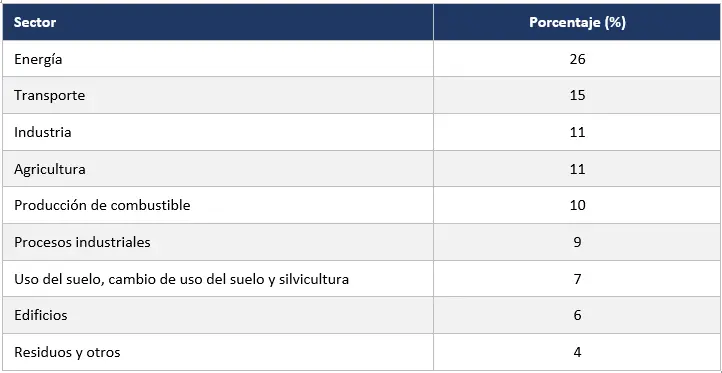
The key point is that reducing emissions requires action on multiple fronts simultaneously, and particularly across the food system.
If the global beef industry were a country, it would be the world’s second-largest emitter of greenhouse gases, behind only China and on a similar scale to the United States. If the dairy industry were a country, it would rank among the world’s five largest emitters.
From both a climate perspective and a public health perspective, all the evidence points towards the need to move progressively towards dietary patterns more similar to those of the 1960s.
It is also important to recognise the enormous disparities between countries.
Per capita emissions are highest in countries with abundant, low-cost fossil fuels—such as Saudi Arabia and other Gulf states—alongside the United States, Canada, Russia and Australia.
Where energy is cheap and readily available, there are naturally fewer constraints on its consumption.
The first direct measurement of atmospheric CO₂ was taken in 1958 at the Mauna Loa Observatory in Hawaii by NOAA, recording a concentration of 315 ppm. Today, concentrations exceed 430 ppm.
Looking further back, before the Industrial Revolution atmospheric CO₂ concentrations were around 280–290 ppm, forming part of the Earth’s natural equilibrium. In less than two centuries, we have substantially altered a variable that had remained relatively stable for almost one million years.
It is true that, at other times in the Earth’s geological history, CO₂ concentrations were even higher. But during those periods there was no permanent ice in either Antarctica or the Arctic. In practical terms, what we are moving towards is a planet with very little permanent ice.
And it is not only CO₂. Methane, although measured in parts per billion rather than parts per million, is increasing at a similar rate and has a far greater warming potential than carbon dioxide. Rising meat consumption, together with natural sources, is contributing to increased methane emissions from livestock.
The greenhouse effect is essential for life. Without it, the Earth’s average temperature would be incompatible with life as we know it.
The problem is that human activities are strengthening this natural greenhouse effect. Solar radiation continues to enter the Earth’s system, but an increasing proportion of the heat is unable to escape back into space. More greenhouse gas molecules mean more energy is retained within the climate system. And a system containing more energy is not static: it reorganises itself and becomes increasingly dynamic.
This is an extraordinarily complex system. Science is developing increasingly sophisticated models capable of making predictions with greater confidence, but we are still unable to analyse every variable with complete certainty. The exact timing of future changes may be wrong by years or even decades.
What science does tell us with confidence is that many of these changes will occur if we fail to alter our current trajectory.
And one point deserves particular emphasis: even if we were to reduce emissions to zero tomorrow, the greenhouse gases that have already accumulated in the atmosphere would remain there for a very long time.
The inertia of the climate system is enormous.
Globally, the average temperature anomaly in 2025 reached +1.45°C compared with the pre-industrial period. We are now very close to the 1.5°C threshold established in 2015 as the limit we should avoid exceeding.
Only ten years have passed, and what once appeared to be a minimum objective already seems increasingly difficult to achieve.
The ocean is the planet’s great thermal regulator. It absorbs most of the excess heat trapped by greenhouse gases, as well as a significant proportion of the CO₂ emitted into the atmosphere. But, like any material, water expands as it warms. When this thermal expansion is combined with the additional water entering the oceans from melting land ice, the result is a double contribution to rising sea levels.
The last ten years have been the warmest decade for the world’s oceans since at least the nineteenth century, with record heat accumulating in the upper 2,000 metres of the water column.
Globally, mean sea level has risen by approximately 200 mm since 1900, while the latest satellite observations (January 2025) indicate an increase of 102 ± 4 mm relative to 1993.
This rise is driven primarily by two processes: the melting of land-based ice—including mountain glaciers and the Greenland and Antarctic ice sheets—and the thermal expansion of seawater as it warms.
A local observation at a particular location is not enough to understand this phenomenon. Tide gauges around the world all tell the same story—they are measurements, not opinions. In some places, local sediment accumulation or other factors may temporarily mask the trend, but the global pattern is clear.
To summarise, the world’s population will increase from around 8 billion to 10 billion people, while the estimated lifetime carbon footprint per person will range between 1,200 and 3,000 tonnes of CO₂, depending on levels of consumption.
If current trends continue, atmospheric CO₂ concentrations could reach 550–600 ppm by 2050, while annual greenhouse gas emissions could increase from around 49 gigatonnes to more than 60 gigatonnes.
What could happen if atmospheric CO₂ reaches 600 ppm?
Today, I am perhaps the greatest pessimist of all. At present, I do not see enough courage to fundamentally change the global model. If we continue along the current path—with a growing population, increasing life expectancy, higher incomes and the same patterns of consumption—I believe we are heading closer to 5°C of global warming than to the 2°C or 3°C considered in the IPCC’s intermediate scenarios.
If that happens, the greatest concern is the possibility of crossing what are known as tipping points—critical thresholds within the climate system beyond which relatively small disturbances trigger large, rapid and, in many cases, irreversible changes.
Once these thresholds are crossed, feedback mechanisms—such as the loss of ice albedo or the release of methane—become self-reinforcing and continue even if human emissions are subsequently reduced.
Even more concerning is the possibility that several tipping points may interact in cascade. Melting of the Greenland Ice Sheet, for example, could contribute to a slowdown of the Atlantic Meridional Overturning Circulation, which in turn would alter climate patterns across entire regions.
Scientific evidence has also lowered the temperature thresholds at which these tipping points may be triggered. Whereas two decades ago the IPCC considered them likely above 5°C, more recent assessments suggest that some could be activated between 1°C and 2°C above pre-industrial temperatures.
The Global Tipping Points Report 2023 assessed 26 potential negative tipping points and concluded that, given the warming already observed over recent decades, we are close to crossing five of them.
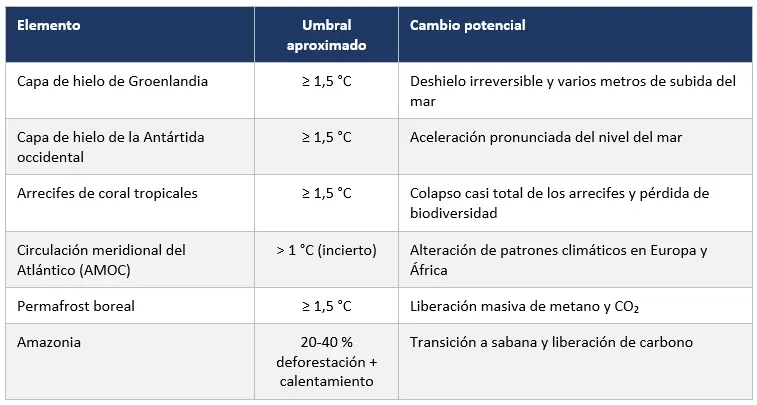
If permafrost begins to thaw and releases greenhouse gases that have remained trapped for millions of years, the projected concentration of 600 ppm could increase far beyond current estimates.
It is worth remembering that Venus, although closer to the Sun than the Earth, has an average surface temperature of around 400°C not because of its proximity to the Sun, but because its atmosphere is saturated with greenhouse gases that prevent heat from escaping.
The existence of these tipping points is well supported by scientific evidence.
What remains uncertain is exactly when they will be crossed and at what level of warming they will be triggered.
For that reason, we should act with caution, avoiding both climate change denial and unnecessary catastrophism. The risk is real, and it increases as global temperatures continue to rise.
Much as we may like to think we are the centre of the universe, the Basque Country is no exception. Our economy and our patterns of consumption are comparable to those of the rest of Spain and Europe. We have a relatively strong industrial base, although its importance is gradually declining. We also have a Climate Change Act and clearly defined targets, and there are sectors that will have to adapt. But we cannot do it alone. If we make political and business decisions that the rest of the world does not follow, we alone will bear the cost.
The available data show a general increase in air temperatures across all three Historical Territories of the Basque Country, with warming rates ranging from 0.1 to 0.4°C per decade, depending on the monitoring station. Sea surface temperatures are following the same trend.
The Basque climate remains generally mild, but it is evolving rapidly towards warmer conditions, in line with the rest of the Bay of Biscay.
Every recorded sea surface temperature above 24°C in Basque waters has occurred since 1990. Although short-term anomalies may occur, the thermal inertia of the ocean is very large and the long-term trend is unmistakable: swimming at La Concha beach will become increasingly pleasant.
Despite our relatively mild climate, recent history has been marked by weather events that have caused extremely significant damage.
According to the Spanish Insurance Compensation Consortium, the floods of August 1983 in the Basque Country caused €968 million in damages. Cyclonic Storm Klaus in January 2009 resulted in €653 million in losses across the Basque Country, while the floods of June 1997 caused a further €132 million in damages. Coastal storms between 10 and 12 March 2008 generated losses estimated at €15 million, while those of 2 February 2014 caused around €19 million in damages, particularly affecting Donostia-San Sebastián, Zarautz, Bermeo, Deba, Orio and Ondarroa.
Sea level along the Basque coast is rising at a rate of almost 4 mm per year, consistent with observations across the Bay of Biscay. The latest IPCC AR6 projections for the SSP2-4.5 and SSP5-8.5 scenarios indicate a relatively narrow range of projected sea-level rise by 2100.
Adaptation is therefore essential.
There is considerable scope for adaptation, but there are also limits and barriers. Broadly speaking, there are three possible responses: protection, accommodation and managed retreat.
In urban areas, managed retreat is often not a realistic option. Consequently, looking towards 2050, the most viable approaches are protection and accommodation. This requires stronger governance through planning regulations that minimise risk and impacts, effective warning systems for the public and relevant stakeholders, and one fundamental principle: we must not increase the exposure or vulnerability of people and assets.
The simulations available for Basque beaches illustrate the scale of the challenge. Hondarribia beach, which currently covers around 12 hectares, could lose more than half of its surface area according to current projections.
We can probably live with less dry sand and fewer beach umbrellas.
What is truly worrying is not the beaches themselves, but the consequences of increasingly frequent flooding in populated areas. What society considers exceptional today could become far more common if events such as the Bilbao floods of forty years ago were to occur every decade.
This brings us to the technical heart of the issue.
How do we prepare for all of this?
Information systems provide the foundation for climate action. The sequence is as follows:
If the starting point—the data—is not reliable, everything that follows is built on weak foundations.
That is why the first priority must be to ensure that we have high-quality data.
Data that, following internationally recognised principles, are FAIR: Findable, Accessible, Interoperable and Reusable.
This is not about one organisation owning the data. It is about cooperation between many different organisations. Most of the world’s meteorological services are moving towards open data models so that everyone can build their own analyses and applications.
These data are used not only to forecast tomorrow’s weather, but also to anticipate what may happen in an urban area such as Bilbao twenty years from now.
If the weather forecast is wrong and a planned day at the beach turns into a rainy one, the personal consequences are relatively minor.
If the decision concerns buying a house in an area at risk of flooding, the consequences are of an entirely different magnitude.
Science transforms data into flood-risk maps and decision-support tools that are already available to the public.
The responsibility to make use of that information also lies with each of us.
With the support of the Basque Government, Naturklima, the Provincial Council of Gipuzkoa and a range of European projects, AZTI operates an observation system that now integrates more than 90 long-term data series and over 512,000 observations, with historical records extending back as far as forty years.
The observatory covers four broad groups of indicators:
Technology is steadily reducing the cost of collecting environmental data.
Years ago, obtaining a single observation required organising a dedicated survey and collecting samples in the field. Today, we have real-time sensors, autonomous underwater gliders launched from Pasaia that travel across the Bay of Biscay, dive to depths of 1,000 metres and periodically surface while continuously transmitting data.
The more physical, chemical and biological information we integrate, the better we become at calibrating models and understanding the changes taking place in the marine environment.
The Basque Operational Oceanography System (EuskOOS)—operated by AZTI in collaboration with the Basque Government and Euskalmet—has progressively expanded its capabilities over the past two decades. These now include coastal monitoring stations (since 2003), deep-water buoys (2007), coastal video monitoring (2009), high-frequency radars (2010), high-frequency tide gauges (2015), gliders or autonomous underwater vehicles (AUVs, 2018), and autonomous surface vehicles (ASVs, 2022).
The coastal and offshore stations measure wave height and period, tides, wind, atmospheric pressure, air temperature, visibility and solar radiation, as well as water temperature, salinity and currents throughout the water column down to a depth of 200 metres.
The coastal video monitoring system—operated under the KOSTASystem by AZTI brand and now deployed in numerous locations along the Basque, French, Mediterranean and Canary Island coastlines—makes it possible to monitor shoreline evolution, beach morphology, coastal hazards such as flooding and overtopping, rip currents and beach occupancy.
High-frequency radars generate maps of surface currents, enabling the study of transport processes and marine connectivity.
Gliders provide vertical profiles of temperature, salinity, dissolved oxygen, chlorophyll-a, turbidity, dissolved organic matter, nitrates and the acoustic abundance of pelagic species.
All these data are channelled through the EuskOOS portal (euskoos.eus), where they are freely accessible to all users, and through the enhanced e-begi observatory (aztidata.es/ebegi), which integrates multi-platform ecosystem observations under an open data philosophy.
At a broader scale, these data are also connected to European observing networks such as Copernicus Marine In Situ TAC, EMODnet, JERICO and EuroSea.
Who benefits first and foremost from all this information?
One of the principal users is Euskalmet, the Basque Meteorological Agency. In many respects, AZTI provides the marine data acquisition back office that supports its forecasting activities.
The information is also used by the Basque emergency services, municipalities, provincial councils and port authorities.
Predicting whether tomorrow will be a suitable day to go to the beach is the visible part of the system.
Anticipating the risk posed by severe weather events in order to activate civil protection protocols is the critical part.
None of this is done in isolation.
We work in coordination with sister observing networks in the Mediterranean, Brest and other European nodes. Local information, combined with local information from elsewhere, and then with information from yet another location, is what ultimately provides us with a reliable global picture.
This networked way of working is particularly evident in EuskOOS, but it also underpins the Gulf of Biscay Climate Change Observatory, whose data are used by organisations such as Naturklima and Ihobe. These data are made openly available so that citizens, local authorities and other stakeholders can develop their own climate change adaptation plans.
