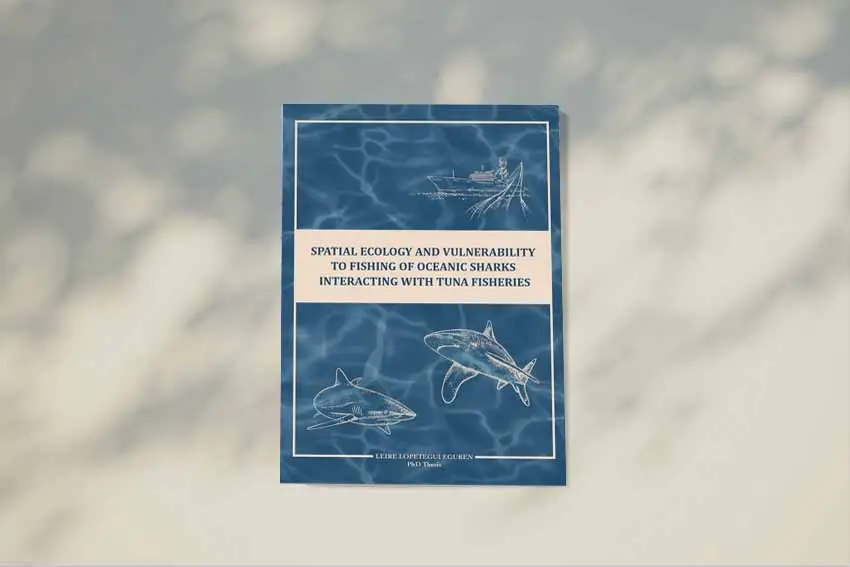
El pasado 13 de marzo Leire Lopetegui Eguren defendió su tesis doctoral titulada: «Spatial Ecology And Vulnerability To Fishing Of Oceanic Sharks Interacting With Tuna Fisheries» en el PIE de la Universidad del País Vasco (EHU).
La investigación se ha desarrollado en AZTI, bajo la dirección de los doctores Haritz Arrizabalaga (AZTI) y María José Juan Jordá (IEO), y se ha realizado en el marco de los proyectos Marine Beacon y Biocean5D.
La tesis obtuvo la calificación de Sobresaliente Cum Laude.
This thesis addresses a central challenge in the conservation and management of pelagic ecosystems: understanding the spatial ecology and vulnerability to fishing of oceanic shark species that are frequently caught as bycatch in tuna fisheries, specifically the oceanic whitetip shark and the silky shark. These species perform essential ecological roles as apex predators, yet their populations have undergone severe declines due to overfishing and the chronic lack of detailed biological and fisheries data. Their life-history traits—slow growth, low fecundity and late maturity—render them highly susceptible to fishing mortality, while limited monitoring and low observer coverage across most tuna fisheries hinder the development of traditional fishery stock assessments.
In this context, the thesis develops and applies a framework that integrates advanced species distribution modeling (SDM) using fisheries-dependent data and a spatial ecological risk assessment tool. This framework generates decision-relevant scientific evidence to support the management of data-poor bycatch species under the purview of tuna Regional Fisheries Management Organizations (tRFMOs). Specifically, it addresses two linked questions: (i) where and under which environmental conditions these oceanic sharks are most likely to occur, and (ii) how cumulative exposure to multiple fisheries translates into vulnerability status and the relative effectiveness of alternative conservation and management measures (CMMs) aimed to mitigate bycatch impacts are most likely to reduce vulnerability status under uncertainty.