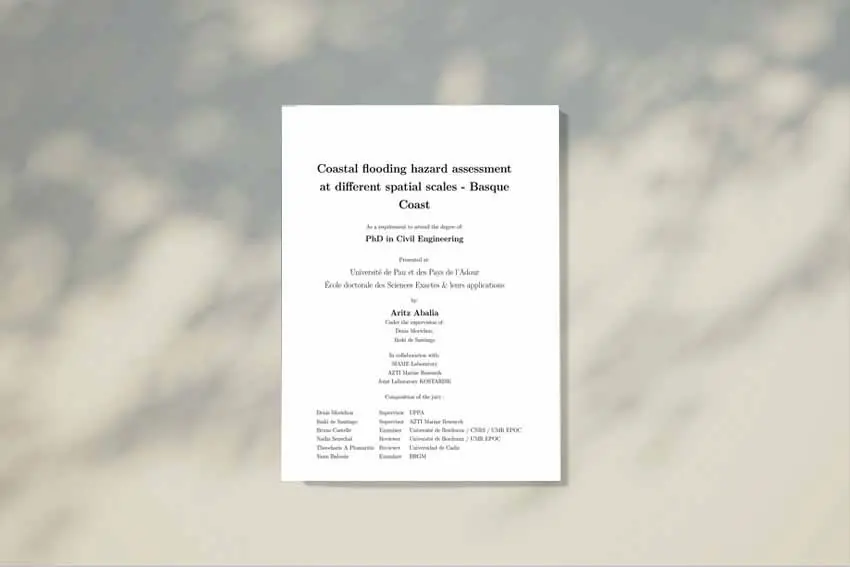
El 14 de marzo, Aritz Abalia defendió su tesis doctoral en la Université de Pau et des Pays de l’Adour, Francia. La tesis, titulada “Coastal flooding hazard assessment at different spatial scales – Basque Coast”, fue supervisada por Denis Morichon (Université de Pau et des Pays de l’Adour) e Iñaki de Santiago (AZTI). Este trabajo se centró en el estudio del impacto de las inundaciones costeras a lo largo de la Costa Vasca. El trabajo se llevó a cabo con el apoyo del proyecto Urban Klima 2050 (LIFE 18 IPC 000001), en el que participa AZTI, financiado por el programa Life de la Unión Europea.
El tribunal, compuesto por Nadia Sénéchal (Université de Bordeaux / UMR EPOC), Theocharis A Plomaritis (Universidad de Cadiz), Bruno Castelle (Université de Bordeaux / CNRS / UMR EPOC) y Yann Balouin (BRGM Service géologique national) destacó la calidad de la presentación escrita y oral, el enfoque pedagógico y la capacidad de integrar diversas metodologías en su tesis, demostrando una profunda comprensión de la temática.
Coastal flooding, caused by natural events and intensified by urbanization and climate change, poses severe risks to communities. Coastal flooding assessment frameworks are presented as a structured approach to identify, predict, and evaluate the risks and impacts of coastal flooding on communities, infrastructure, and ecosystems.
The present PhD thesis aims to develop a coastal flooding hazard assessment framework from regional to local scale. Observation and modeling tools are coupled to assess, identify and predict the impact of storms considering the associated uncertainty. More specifically, the project aims to: i) identify the most affected beaches by coastal flooding at regional scale, ii) develop and validate a local scale process-based Early Warning System (EWS) and iii) quantify the uncertainties on the EWS predictions. The Basque Coast (northern Spain) constitutes the study site. It is representative of a highly exposed coastal area to storms, densely populated, with a great variety of embayed beaches located in highly urbanized environments. In addition, it has been monitored for several years through a dense network of video monitoring systems operated by AZTI.
First, the extensive videometry network of the Basque Coast is utilized to assess coastal flooding hazards at regional scale. The data collected by the stations consists of different type of images, that are processed to extract quantitative data of morphological shoreline position and storm impact data (i.e. swash/collision/overtopping).
The storm impact data is collected for 31 events between 2019 and 2022 and compared across 13 beaches. Then, the storm impact data is compared against nearshore hydrodynamic, morphological, and structural parameters of the 13 beaches. The results show that storm impact intensity varies along Basque beaches for the studied hydrodynamic conditions. Wider dry beach widths and higher dune/seawall toe and crest heights correlate with lower storm impact intensity. Morphological parameters have a greater influence on coastal flooding intensity than nearshore hydrodynamic conditions for the studied events. Among the studied beaches, Zarautz is identified as the most affected area to storm impacts due to its specific morphological and structural characteristics. For this reason, it is chosen as the pilot site for developing a process-based EWS.
Second, the development and validation of a process-based EWS is conducted at Zarautz beach to provide timely warnings with information on severity, timing and affected areas of coastal flooding potential hazards. This system is composed by three modules: i) the Spectral Simulating Waves Nearshore (SWAN) model to propagate wave conditions from deep to intermediate water depths, ii) the XBeach non-hydrostatic (XBNH) phase-resolving depth-averaged model to compute wave transformation and overtopping processes in shallow foreshores, and iii) the EW-Coast hazard scale to classify the expected intensity of storm impacts based on the computed mean overtopping discharge into no damage, minor damage, damage and severe damage. The optimum EWS configuration is obtained through calibration and validation analysis by comparing the computed results against a video-based validation dataset for varying hydrodynamic conditions. The developed system provides accurate predictions, however, the inaccurate representation of physical boundary conditions can generate uncertainty in the results.
Third, the uncertainty assessment of the influence of the variability in hydrodynamic and morphological boundary conditions in the EWS results is carried out at Zarautz beach. The analysis utilized 90 synthetic events and 32 synthetic profiles that
encompass the full range of the available data. Hydrodynamic boundary conditions can introduce up to three levels of hazard of uncertainty (ranging from no damage to severe damage), while morphological conditions are limited to two levels (from no damage to damage, and from minor damage to severe damage). The dry beach width and beach foreshore slope contribute more to uncertainty than the toe of the structure and the positions of the inner and outer bars. The uncertainty in the forecasted hazard level due to dry beach width and beach foreshore slope increases during low-energy storms. Additionally, the uncertainty related to morphological parameters slightly rises with a greater vertical distance between the water level and the crest of the structure. This uncertainty is controlled by the significant wave height of short waves in the intertidal zone, and infragravity waves in the supratidal zone.
The results obtained underline the potential and limitations of observation and modeling tools within a multi-scale coastal flooding assessment framework. Moreover, they also prove the great added value of the regional scale data obtained from the Basque Coast coastal videometry network, highlighting the need of an adequate maintenance. The uncertainties in the EWS predictions at local scale highlight the need of further research in the topic.