News
Content index
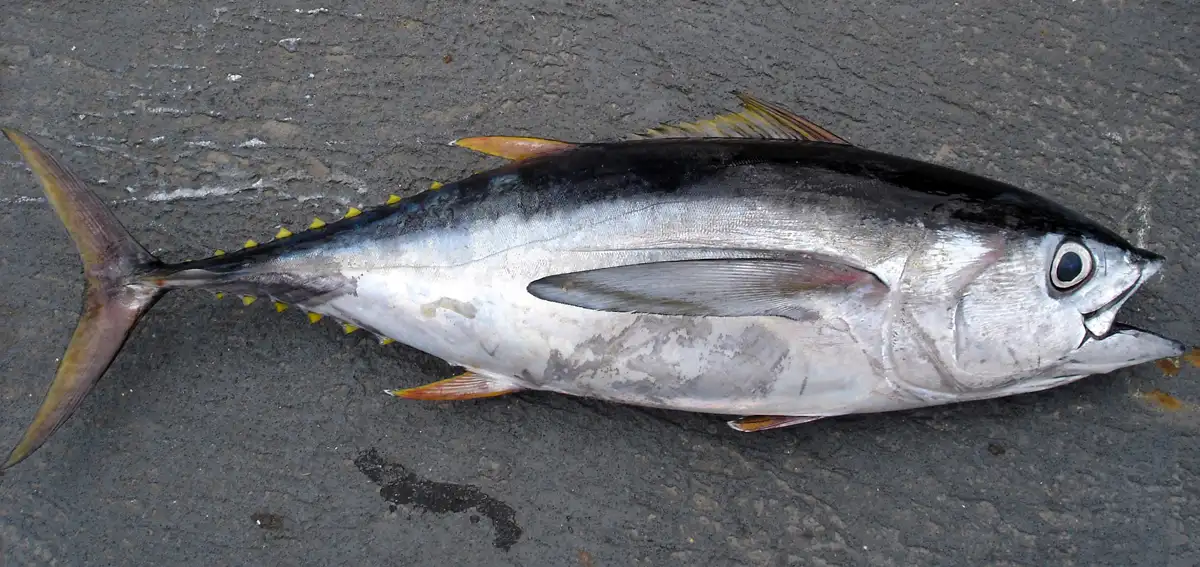
Pasaia, 23 June 2026. The recapture of a bigeye tuna tagged almost ten years ago provides a rare opportunity to improve our understanding of bigeye tuna growth and to strengthen the evidence base underpinning fisheries management. The Galician longliner Escualo Cuatro, owned by the fishing company MAZAIDO, recently caught a bigeye tuna (Thunnus obesus) carrying an external tag in the equatorial Atlantic. The fish was originally tagged in August 2016 off Cape Verde by an AZTI scientist as part of ICCAT’s Atlantic Ocean Tropical Tuna Tagging Programme (AOTTP).
The crew of the Escualo Cuatro recognised the tag, retained the fish and notified ICCAT as well as researchers from AZTI and the Spanish Institute of Oceanography of the Spanish National Research Council (IEO-CSIC). Thanks to this collaboration between the fishing, scientific and management sectors, the specimen can now provide highly valuable biological information.
Fish have small calcified structures called otoliths that record growth throughout their lives, much like the rings of a tree. In a sense, they are the fish’s black box: reading them allows scientists to reconstruct its age and growth rate with remarkable accuracy.
In 2016, during ICCAT’s AOTTP tagging campaign, an AZTI researcher injected a chemical compound into a young bigeye tuna measuring just 55 cm, leaving a permanent, precisely dated mark in its bones. Nearly ten years later, that same fish was recaptured. It had grown to 158 cm in length and weighed 79 kg.
That chemical signal now serves as an unequivocal reference point. By examining the otolith under a microscope, scientists can clearly distinguish the growth rings formed before and after tagging, as well as those corresponding to the almost ten years that elapsed before recapture.
“This tagged fish is a unique reference specimen: it allows us to read with certainty what, in other individuals, we can only estimate. Its otolith helps us validate the reading criteria and methods that we apply to the entire population,” explains Patricia Lastra, researcher at AZTI.
The analysis of this specimen forms part of the European ITUNNES project, which aims to improve biological knowledge of tropical tunas and strengthen the scientific basis for fisheries management decisions.
“That level of detail—knowing exactly how much a fish has grown between tagging and recapture, and verifying that the growth rings accurately reflect that interval—is what allows us to build reliable growth curves, information that is essential for the models we use to assess the status of fish stocks,” adds Lastra.
Fisheries management decisions, such as catch quotas and conservation measures, are based on scientific assessments that estimate the status of fish populations. For those assessments to be reliable, key aspects of species biology—including growth—must be accurately understood. Knowing how fast a fish grows influences everything else: when it reproduces, how long it lives and, ultimately, how many fish are available to support fisheries.
Bigeye tuna grows slowly and takes several years to reach maturity. If its age is estimated incorrectly—particularly its age at first maturity—estimates of population abundance become biased, and fisheries advice may either underestimate or overestimate sustainable catch levels, affecting both the tuna population and future fishing opportunities. Reducing this uncertainty is far more than a technical detail: it is what makes the difference between precautionary management and management that reacts too late.
Robust growth estimates are not only essential for conserving the species. They also influence the sustainability of a strategically important food source and the stability of the communities and economic sectors that depend on tuna fisheries in many countries around the world.
“Every tagged and recovered fish is of immense scientific value. This particular specimen, however, spans almost an entire lifetime,” concludes Patricia Lastra, AZTI researcher.
This finding would not have been possible without the commitment of those who work at sea every day in the Atlantic. Recognising the tag, deciding to retain the fish intact and ensuring that it reached the researchers required knowledge, willingness and a relationship of trust built over many years between the fishing sector and the scientific community.
That partnership is what gives tagging programmes their value. Thanks to recovered fish, carefully preserved samples, fishers who understand the importance of their contribution, and the collaboration and coordination among research teams promoted by ICCAT, tuna fisheries science remains closely connected to the reality it seeks to understand.
Once landed in port, the specimen was preserved thanks to the collaboration of the Galician cold-storage company WOFCO before being transferred to the ITUNNES scientific team. This chain of collaboration, built on the initial coordination work of the ICCAT Secretariat, involved the fishing company MAZAIDO, IEO-CSIC and AZTI, linking work at sea directly with the generation of scientific knowledge that is essential for the sustainable management of fisheries resources.
The analysis of this bigeye tuna is being carried out within the framework of the European project ITUNNES (Improving Tropical tUNa kNowledge for End userS), funded by the European Climate, Infrastructure and Environment Executive Agency (CINEA) and coordinated by AZTI under the European Maritime, Fisheries and Aquaculture Fund (EMFAF).
Its results will feed directly into the stock assessment models used to support international fisheries management decisions, helping to ensure that fisheries sustainability is underpinned by robust and up-to-date scientific evidence.