News
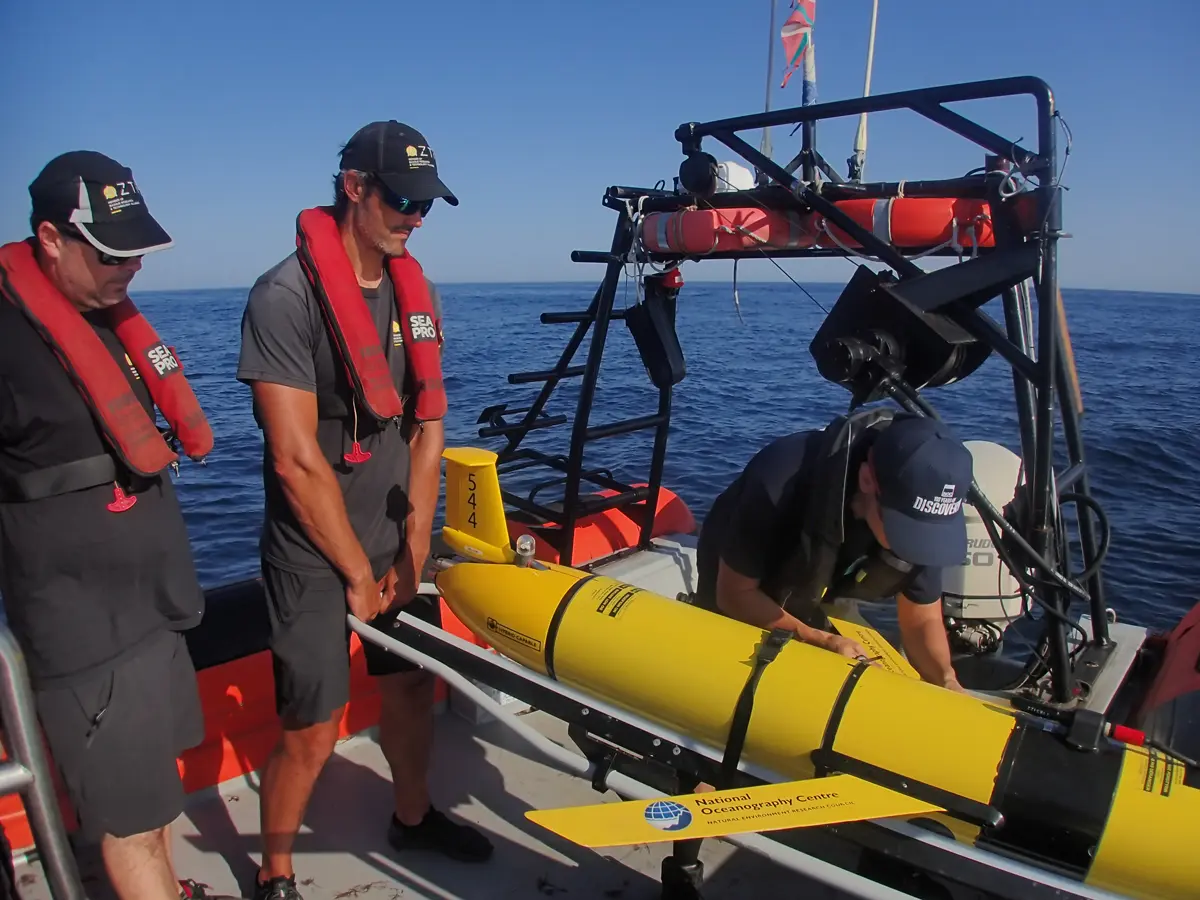
Following the recent deployment of several scientific moorings in the Bay of Biscay, AZTI, through its Pasaia Ocean Autonomy (POA) infrastructure, has collaborated with the UK’s National Oceanography Centre (NOC) in the launch and operation of a Slocum glider, an autonomous underwater vehicle designed to carry out long-duration oceanographic observations with very low energy consumption.
The work forms part of the PYCNOGEN project, an international collaboration aimed at improving the ability of gliders to navigate and determine their position underwater over extended periods, reducing the need to surface and increasing their operational autonomy. The operational environment provided by POA enables these developments to be validated under real sea conditions, a critical step before deployment in remote or hard-to-access regions.
The activities carried out in the Bay of Biscay, supported by POA’s technical and operational capabilities, will serve as preparation for a scientific campaign in Antarctica next year. The mission will investigate the processes involved in the formation of the permanent pycnocline of the Southern Ocean, a key oceanographic feature for understanding ocean dynamics and their influence on the global climate system.
An infrastructure open to collaboration and technological development
Beyond its scientific value, this initiative highlights Pasaia Ocean Autonomy (POA) as a real-world environment for the development, validation and operation of autonomous marine technologies.
POA offers companies, research organisations and public authorities the opportunity to:
The infrastructure combines direct access to the sea, specialised technical facilities, support vessels and extensive operational expertise in the use of gliders, unmanned surface vehicles and marine drones. This enables organisations to reduce costs and operational risks compared with traditional campaigns relying exclusively on research vessels.
The Bay of Biscay as a testing ground for global solutions
The oceanographic conditions of the Bay of Biscay, together with AZTI’s expertise in autonomous ocean observation, make it an ideal environment for developing solutions that can subsequently be deployed anywhere in the world, from coastal waters to polar regions.
The collaboration with NOC exemplifies the type of projects that can be supported through POA: initiatives that combine technological development with scientific application and enable solutions to be validated under real operational conditions before deployment in demanding environments.
For AZTI, projects such as this contribute to addressing international scientific challenges while further strengthening Pasaia Ocean Autonomy as a leading infrastructure for the development of marine autonomous systems.
POA also serves as a hub connecting technology developers, operators, researchers and end users, facilitating knowledge transfer and accelerating the adoption of autonomous solutions in areas such as ocean observation, environmental management, offshore energy, aquaculture, fisheries and maritime safety.