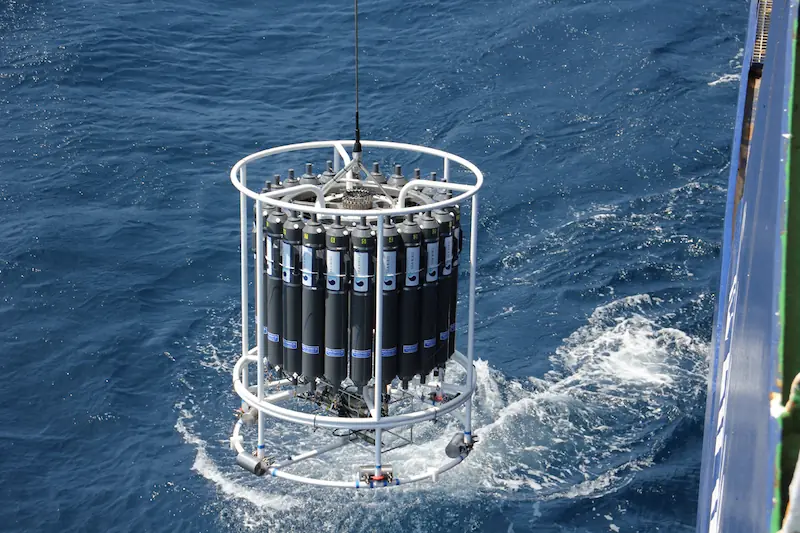
Estimating how many fish inhabit the ocean remains one of the most complex and important challenges in fisheries science. In the case of small pelagic species such as anchovy, this difficulty is even greater: their biomass varies significantly over time and space, and they are highly dependent on environmental conditions. Yet, given their key role in marine ecosystems and their major economic value, accurately estimating their biomass is essential for sustainable fisheries management.
For decades, acoustic methods combined with trawl sampling have been the benchmark for estimating the abundance of small pelagic species. These approaches provide robust, standardized data and allow for the coverage of large areas. However, fishing nets cannot reach certain depths, and some fish actively avoid them. As a result, catches cannot fully validate everything detected acoustically, nor do they always accurately represent what is truly present in the water. In this context, both the European Commission and ICES have shown growing interest in exploring complementary approaches that can optimize sampling effort and reduce the impact of survey campaigns.
Environmental DNA: a new way of observing the ocean
In recent years, environmental DNA (eDNA)—DNA collected from environmental samples such as seawater—has opened up a new, non-invasive and logistically simpler way of observing marine ecosystems. The key question until now has been whether eDNA could be used to monitor fish diversity and abundance, something that numerous studies have already confirmed. The current challenge is therefore no longer to prove its usefulness, but to determine how to rigorously and reliably integrate these data into fisheries assessment processes, ensuring their added value for sustainable resource management.
Moving toward the potential use of eDNA as a partial or even full alternative to traditional methods requires a gradual and robust approach. The logical first step is to complement existing tools—such as acoustics—with the information derived from eDNA analysis.
At AZTI, we have been working along these lines for several years. Recently, we defined a way to combine acoustic and eDNA data to estimate the biomass of European anchovy (Engraulis encrasicolus) in the Bay of Biscay. The results of this work have just been published in the ICES Journal of Marine Science.
Two different perspectives on the same biological reality
Both acoustic data and eDNA provide indirect measures of abundance. Acoustic methods rely on the intensity of sound waves reflected by fish schools, while eDNA analysis measures the concentration of species-specific DNA particles in the water. Although both signals are imperfect, they are positively correlated with actual biomass: the more fish there are, the stronger the acoustic signal and the higher the detected DNA concentration.
The key lies in the fact that these methods do not capture exactly the same information, nor in the same way—and this is precisely where their potential as complementary data sources emerges.
A joint model to bring the pieces together
In this study, we used data collected over six years (2018–2023) during the JUVENA survey. This dataset included 196 acoustic transects processed according to standard protocols and 255 water samples analyzed using digital PCR—a highly precise technique that enabled absolute quantification of anchovy DNA copies per liter of water.
Rather than analyzing these data sources separately, we developed a joint Bayesian model that assumes both the acoustic signal and eDNA concentration depend on a shared latent variable: the true anchovy biomass. This approach makes it possible to:
- Integrate data with very different structures and characteristics
- Account for variability and uncertainty in each source, correcting potential biases
- Estimate spatial biomass patterns by combining both lines of evidence
The goal is not to replace acoustic methods, but to put eDNA to work alongside them in a statistically and ecologically coherent way.
What does eDNA add when combined with acoustics?
The joint estimates obtained are consistent with existing knowledge about the spatial distribution of anchovy in the Bay of Biscay, mainly concentrated on the continental shelf. However, eDNA suggests a somewhat broader spatial distribution, indicating that it may enhance detectability and serve as a quality control layer for acoustic indices.
Looking ahead
The main takeaway is clear: when properly integrated, eDNA can help reduce uncertainty, detect false absences, and enrich our spatial understanding of fish stocks. This approach aligns closely with current recommendations from ICES and the European Commission, which promote the development of innovative methods to optimize survey design, reduce costs, and minimize sampling impacts.
However, the study also highlights important challenges. Since eDNA sampling is often opportunistic, it tends to be less consistent and less extensive than acoustic sampling, limiting its spatial resolution. In this work, it was necessary to aggregate data across multiple years to achieve sufficient coverage, preventing the analysis of interannual variability—a key aspect in fisheries management. For this reason, the study should be understood as a proof of concept rather than a ready-to-implement solution for annual stock assessments.
That said, the value of eDNA lies not only in its role as an additional data layer, but also in its potential to progressively optimize—and eventually partially replace—some components of traditional sampling. With more systematic and coordinated sampling designs, eDNA could help reduce the need for intensive acoustic surveys, improve spatial efficiency, and strengthen the robustness of biomass estimates, particularly in resource-limited contexts.
In this direction, AZTI has already taken the next step. Starting in 2024, eDNA sampling within the JUVENA survey is being aligned with fixed hydrographic stations, opening the door to more detailed annual analyses and a more operational integration of eDNA into fisheries assessments. This progress will be key in evaluating, in the short to medium term, the extent to which eDNA can help reduce reliance on intensive acoustic campaigns while maintaining—or even improving—the quality of information available for fisheries management.
—
This work has been made possible thanks to co-funding from regional, national, and European institutions. The JUVENA survey is funded by the Basque Government, through the Department of Economic Development, Sustainability and Environment and the Vice-Ministry of Agriculture, Fisheries and Food Policy (Directorate of Fisheries and Aquaculture), as well as by the Spanish Institute of Oceanography and the General Secretariat for Fisheries of the Government of Spain.
In addition, this research has received funding from the European Union’s Horizon 2020 programme through the OBAMA-NEXT project (grant agreement No. 101081642) and the BIOcean5D project (grant agreement No. 101059915), as well as from the Basque Government’s Department of Education through a predoctoral grant awarded to Cristina Claver.
- Scientific article: Claver, C., Sobradillo, B., Mendibil, I., Canals, O., Boyra, G., Ibaibarriaga, L., Kelly, R. P., & Rodríguez-Ezpeleta, N. (2026). Integrating eDNA and acoustic-trawl data to provide small pelagic biomass estimates for fish stock assessment. ICES Journal of Marine Science, 83(2), fsag005. https://doi.org/10.1093/icesjms/fsag005