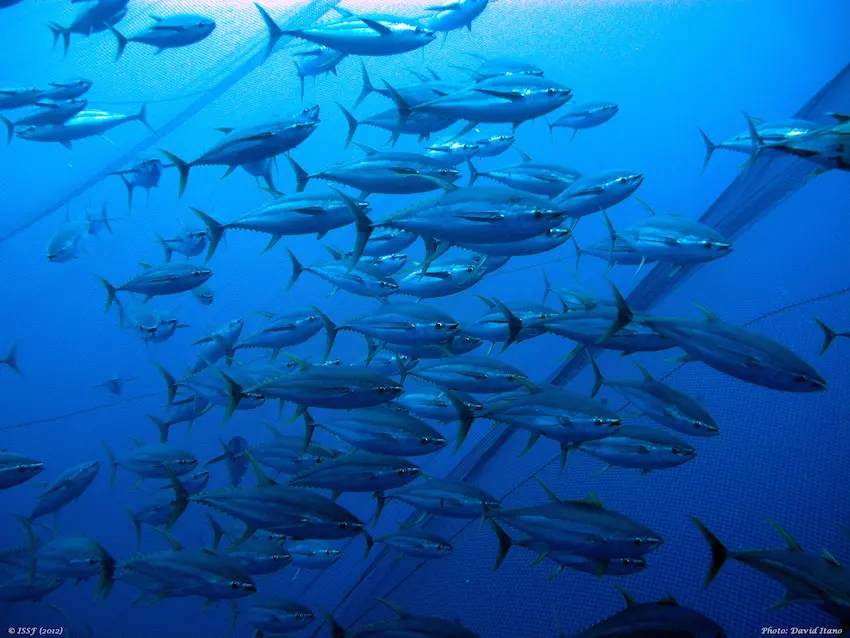
Photo by David Itano for ©ISSF.
In recent years, the status of the main tuna stocks in the Atlantic Ocean has improved. However, the outlook for other, more vulnerable species caught as bycatch—such as sharks—shows signs of deterioration, putting the sustainability of tuna fisheries in the region at risk. At the same time, the International Commission for the Conservation of Atlantic Tunas (ICCAT) is increasingly working to align with international policies and commitments that call for the development of integrated tools to support fisheries management under an ecosystem-based approach, commonly known as the Ecosystem Approach to Fisheries Management.
An ecosystem model to better understand the impact of fishing and climate change
At AZTI, a technology centre specializing in marine and food research, we are developing an ecosystem model that will provide new insights into the structure and functioning of the tropical Atlantic Ocean ecosystem. This model analyzes the impact of fishing activity, as well as other pressures such as environmental variability and climate change.
Specifically, we are developing an Ecopath with Ecosim (EwE) model, a widely used ecosystem modelling software that simulates the marine environment and all its biotic components—that is, all living parts of an ecosystem. These range from primary producers to top predators such as sharks and cetaceans, including commercially important species such as tropical tunas (yellowfin, bigeye, and skipjack) and billfish, as well as the main fishing fleets operating in the area.
This work involves compiling and integrating a vast amount of biological information on the species present in the study area, along with fisheries data including catches of both commercial and non-commercial species (such as discards of vulnerable species).
Ecopath provides a static “snapshot” of the ecosystem and the interactions between species. This has enabled us to characterize the structure and functioning of the ecosystem during a specific period (in this case, 2000–2003), and to derive a set of ecological indicators that inform on ecosystem status and potential impacts.
We are currently developing the dynamic temporal model Ecosim, which simulates changes in biomass, environmental effects, and trophic structure over time. This allows us to fit the model to historical time series of biomass and catches (2003–2022), and to explore the historical dynamics of the ecosystem considering both fishing fleet trajectories and environmental drivers such as temperature and primary production.
Simulating change to anticipate the future
This dynamic model will enable future simulations of ecosystem changes under different fishing and climate change scenarios, helping us anticipate plausible future situations in the tropical Atlantic Ocean. This is particularly important in such a dynamic region, both in terms of oceanographic conditions and fisheries activity.
For example, while the fishing effort of European tuna fleets in the Atlantic is shifting towards other oceans, new fishing powers may emerge in the region. In a context of global change—such as the impacts of climate change—the potential effects on tropical tuna populations and their ecosystem remain uncertain.
Ultimately, having this type of tool is highly valuable for improving our understanding of the marine environment, ensuring the sustainable use of fisheries resources and ecosystems, and advancing towards the implementation of an ecosystem-based approach to fisheries management.
—
This article was originally published in the January issue of Ruta Pesquera magazine.
—
This work is being carried out within a doctoral project funded by the IKERTALENT 2022 programme of the Basque Government’s Department of Economic Development, Sustainability and Environment, and is aligned with the European project BIOcean5D, funded by the European Union under the Horizon programme.