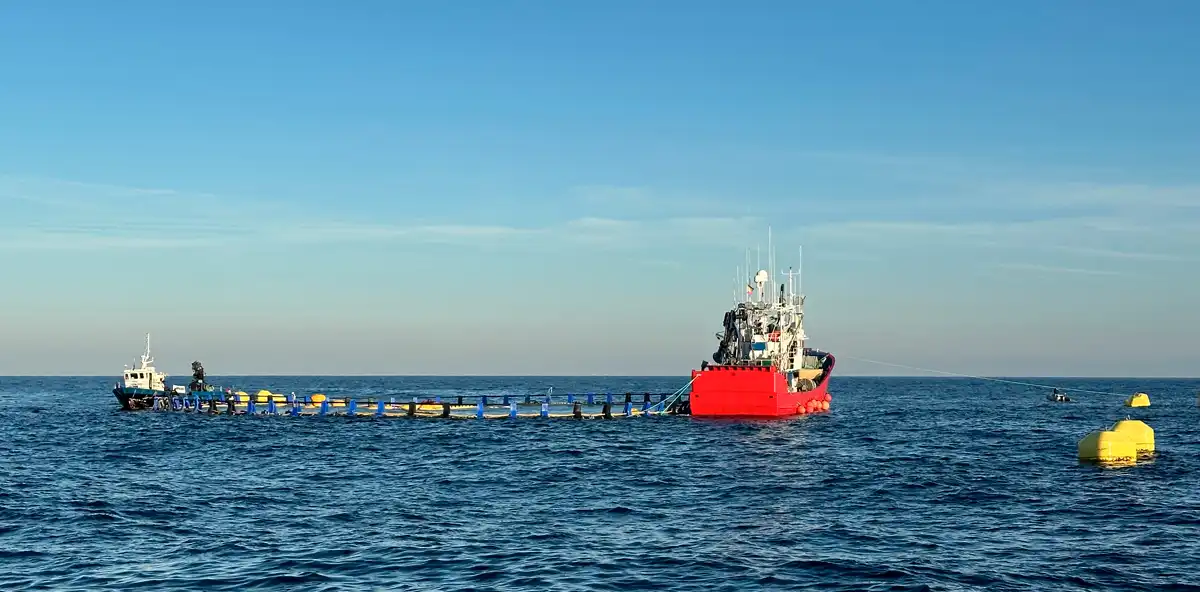
A study by AZTI confirms that the first year of tuna farming activity at Itsas Balfegó had a reduced environmental impact, according to environmental DNA analyses.
To assess the potential impact of an aquaculture facility on its surroundings, researchers from AZTI conducted the FATUNAMON project, supported by the Provincial Council of Gipuzkoa. The objective was to evaluate the ecological situation around the Itsas Balfegó installation, specifically water quality and the condition of marine sediments, using the environmental DNA technique.
The core idea is that all living organisms leave traces of genetic material in their environment. By analyzing this DNA present in water or sediments, information about a zone’s biological communities can be obtained without needing to identify each organism individually under a microscope. In the FATUNAMON project, this genetic information was combined with oceanographic models simulating water circulation to better interpret what was happening around the facility and assess sediment conditions.
Various analyses pointed in the same direction: during its first year of operation, Itsas Balfegó had a very limited environmental impact. Nearby sediments maintained a quality consistent with the area’s natural conditions, and the results aligned with those obtained from conventional monitoring of seafloor macroinvertebrates.
The project also demonstrated that DNA-based microbial indicators, developed from the study’s own data and information from salmon aquaculture, can be applied to monitor offshore tuna farming facilities. While the results are positive, they are not yet definitive. During the studied period, production was lower than projected for the coming years. Analyses will need to be repeated as activity increases to confirm if the situation remains stable.
The significance of FATUNAMON extends beyond its findings for this specific installation. It also opens the door to incorporating environmental DNA as a monitoring tool for offshore aquaculture, offering the sector and administrations a new way to understand ecosystem dynamics.