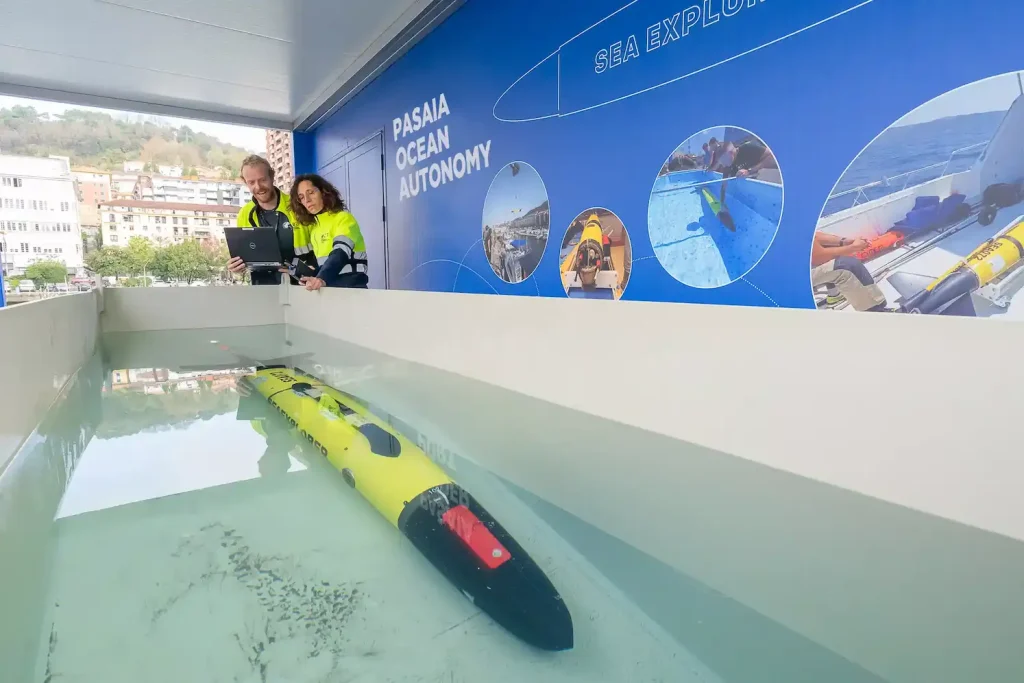
Through Pasaia Ocean Autonomy (POA), we operate a pioneering infrastructure in Spain for the deployment and management of autonomous marine systems (MAS). These platforms—gliders, marine drones, and unmanned surface vehicles (USVs)—provide access to high-resolution data in hard-to-reach areas, reducing costs and operational risks compared to traditional surveys. We combine scientific research with advanced services for companies and public authorities.
Conventional oceanographic surveys rely on crewed vessels: they are costly, limited in space and time, and involve operational risks. Without more frequent, autonomous, and sustainable observations, it is difficult to meet current challenges such as fisheries management, offshore renewable planning, maritime safety, or climate change adaptation.
We operate a fleet of autonomous marine vehicles:
Gliders: underwater platforms capable of multi-week missions, equipped with interchangeable sensors (CTD, echosounders, biogeochemical sensors). They collect parameters such as temperature, salinity, oxygen, and chlorophyll, transmitting data in near real time.
Itsasdrone: a zero-emission, solar-powered surface drone designed with AZTI’s technical input, used for coastal surveillance, current measurements, scientific sampling, and coastguard support.
Ranger 6.0 (USV): a high-capacity vehicle equipped with multiple echosounders and ADCPs, designed for scientific missions and maritime safety operations.
We develop products and applications based on these systems:
Acoustic monitoring of pelagic species (e.g. anchovy, mackerel), validated through fisheries surveys.
Studies of physical processes such as upwelling, river plumes, and seasonal dynamics.
Biogeochemical campaigns to characterise physical–ecological coupling.
Support for coastal observatories and integration into networks such as EUSKOOS, Copernicus, and EuroGOOS.
We provide services to companies and public administrations:
Access to vehicles and data through a dedicated portal under development.
Tailored monitoring campaigns with sensors adapted to client needs.
Real-time and processed data services for operational and environmental decision-making.
Custom sensor development in collaboration with international manufacturers.
Logistics optimisation through low-cost, high spatio-temporal resolution autonomous campaigns, without dependence on crewed vessels.
Technology integration support, including testing of new equipment and development of emerging applications.
We operate a dedicated technical infrastructure in Pasaia:
Own quays, dry laboratory, ballast systems, auxiliary vessels, and direct sea access—creating a unique environment for innovation in autonomous oceanography.
Exclusive, high-resolution, near real-time data in challenging environments.
Reduced costs and operational risks compared to crewed-vessel surveys.
Practical applications across fisheries, aquaculture, offshore energy, port infrastructure, and emergency response.
Strong collaboration in technological innovation, with direct input to manufacturers and co-development of new sensors.
Reinforcement of the Basque Country’s role as a European reference in operational and autonomous oceanography.
Sectors: Fisheries and aquaculture sector, Maritime and port infrastructure, Offshore sector, Technology 4.0
Research lines: Blue Economy, Digitalisation, Environmental resilience and global change, Operational Oceanography
Research sublines: Real-Time Observation and Monitoring