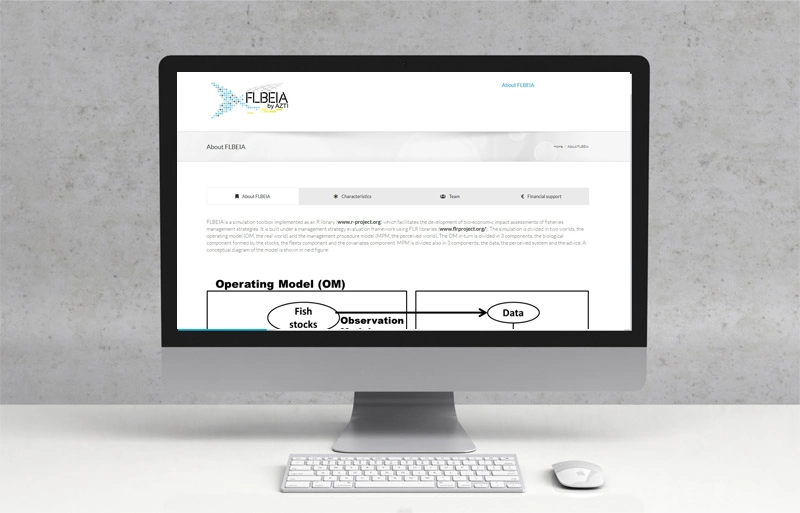
What is FLBEIA?
FLBEIA (Fisheries Library Bio-Economic Impact Assessment) is a bioeconomic simulation model developed by AZTI. It enables users to evaluate how different fisheries management measures affect socio-ecological systems, assessing both the sustainability of fish stocks and the economic and social viability of fisheries.
What challenge does it address?
Fisheries management requires balancing biological, economic, social and regulatory objectives. FLBEIA allows managers and scientists to anticipate the impacts of different management strategies before they are implemented, improving the quality of medium- and long-term scientific advice and supporting decision-making that minimises the unintended consequences of management measures.
How does it work?
Built in the R environment using the FLR libraries, FLBEIA simulates the entire fisheries system by integrating fish stocks, fishing fleets, the management process and relevant external drivers, such as environmental variables.
The model can:
- Simulate multiple fish stocks and fishing fleets simultaneously.
- Apply alternative harvest control rules and management strategies.
- Evaluate outcomes under different scenarios using Monte Carlo simulations.
- Analyse the biological, economic and social performance of fisheries over time.
Key benefits
- Decision support – anticipates the consequences of alternative management strategies, enabling more effective planning.
- Integrated bioeconomic modelling – combines population dynamics with economic models, including fishing effort, catches, prices and capital dynamics.
- Flexible – adaptable to any fishery, fleet, management framework or geographical region.
- Multi-stock and multi-fleet – supports simultaneous assessment of multiple species and fleets.
- Uncertainty analysis – incorporates stochastic simulations to quantify variability and uncertainty.
- Modular and extensible – new components and processes can be incorporated to meet specific case-study requirements.
- Open source – freely available software with supporting documentation and training resources.
- Internationally recognised – validated by European experts and applied in fisheries management plans across the Atlantic and other regions worldwide.
Success stories
FLBEIA has been applied to:
- Assess the impact of the Landing Obligation in the Bay of Biscay and Iberian waters.
- Simulate management strategies for slow-growing deep-sea species.
- Support mixed fisheries management in the Celtic Sea, North Sea and Bay of Biscay.
- Identify harvest control rules for the Bay of Biscay anchovy management plan.
- Evaluate Multiannual Plans (MAPs) across several European Atlantic regions.
- Assess management strategies for albacore tuna and tropical tuna fisheries.
- Support fisheries management in the Strait of Gibraltar, the Northwest Atlantic, the Persian Gulf and the Red Sea.
Scientific publications
FLBEIA has been extensively described in peer-reviewed scientific journals, demonstrating its methodological robustness and establishing it as a recognised tool for fisheries bioeconomic assessment.
- Garcia, D., Andrés, M., Paradinas, I., Alvarez, P., Boyra, G., and Groeneveld, R. A. 2025. Biological, economic and social viability of a mesopelagic fishery in the Bay of Biscay. Fisheries Research, 285: 107348.
- Garcia, D., Arostegui, I., and Prellezo, R. 2019a. Robust combination of the Morris and Sobol methods in complex multidimensional models. Environmental Modelling & Software, 122: 104517.
- Garcia, D., Arostegui, I., and Prellezo, R. 2021. To be or not to be a target: that is the question to manage mixed fisheries. ICES Journal of Marine Science, 78: 2562-2578.
- Garcia, D., Dolder, P. J., Iriondo, A., Moore, C., Prellezo, R., and Urtizberea, A. 2019b. A multi-stock harvest control rule based on “pretty good yield” ranges to support mixed-fisheries management. ICES Journal of Marine Science.
- Garcia, D., Sánchez, S., Prellezo, R., Urtizberea, A., and Andrés, M. 2017. FLBEIA : A simulation model to conduct Bio-Economic evaluation of fisheries management strategies. SoftwareX, 6: 141-147.
- Garcia, D., Urtizberea, A., Diez, G., Gil, J., and Marchal, P. 2013. Bio-economic management strategy evaluation of deepwater stocks using the FLBEIA model. Aquatic Living Resources, 26: 365-379.
- Kühn, B., Kempf, A., Brunel, T., Cole, H., Mathis, M., Sys, K., Trijoulet, V., et al. 2023. Adding to the mix – Challenges of mixed-fisheries management in the North Sea under climate change and technical interactions. Fisheries Management and Ecology, 30: 360-377.
- Prellezo, R., Carmona, I., and García, D. 2016. The bad, the good and the very good of the landing obligation implementation in the Bay of Biscay: A case study of Basque trawlers. Fisheries Research, 181: 172-185.
- Sánchez-Maroño, S., Uriarte, A., Ibaibarriaga, L., and Citores, L. 2021. Adapting Simple Index-Based Catch Rules for Data-Limited Stocks to Short-Lived Fish Stocks’ Characteristics. Frontiers in Marine Science, 8.