Content index
During the design phase of a food product or the modification of an existing one, the costs and environmental impacts of the product are determined, since it is at this stage that the needs for raw and auxiliary materials, transport, transformation processes and technologies, distribution, marketing, final consumption and waste management are determined.
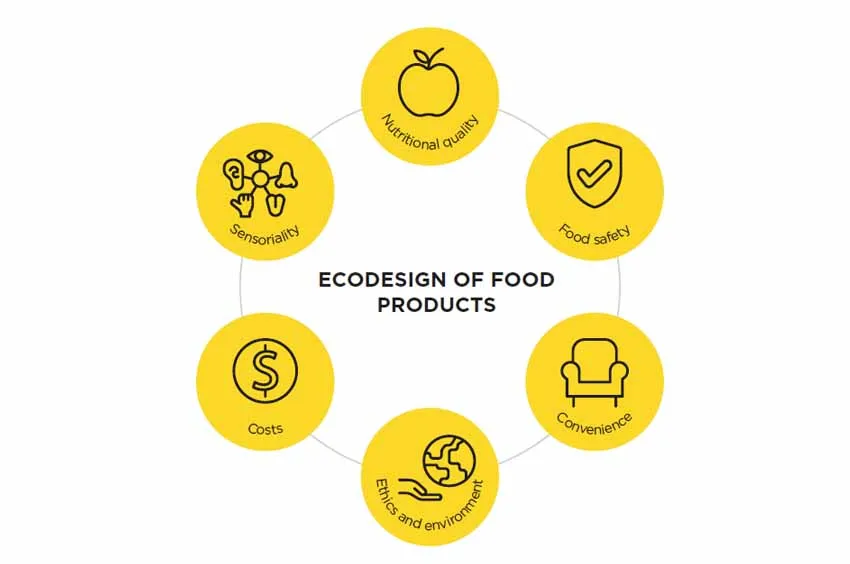
It is therefore necessary to introduce the environmental aspect as an additional conditioning factor when developing new foods or improving existing ones. In this way, it will be possible to reduce the costs associated with the entire life cycle and the consequent environmental impact associated with all stages of the life cycle, while maintaining food quality and safety. This is called ecodesign.
Ecodesign proposes a methodology, based on Life Cycle Assessment, for product design that takes into account, in addition to the traditional aspects, the environmental aspects of all stages of its future life cycle. In this way, the environmental impact of the product is reduced throughout its entire life cycle, i.e. from the extraction of raw materials, through transport, manufacture, distribution and consumption, to the end of its useful life.
Ecodesign plans for the food industry focus on the environmental assessment of aspects such as the search for and selection of raw materials with low environmental impact; the reduction of the use of materials, water and energy; more efficient production and processing techniques with lower consumption; the selection of more efficient transport and distribution methods and strategies; the reduction of impacts at the point of sale and consumption; the extension of useful life and optimization of end-of-life systems; or the reduction of losses, wastage and food waste.
In particular, packaging plays a critical role in the food value chain, protecting, communicating and reinforcing brand image, as well as enabling traceability and convenience. However, it faces challenges due to its environmental impact, particularly the use of single-use plastics. Sustainability trends include eco-design, the use of biodegradable, recycled and compostable materials, and the development of smart packaging that extends the shelf life of food and reduces waste. Actions proposed in eco-design include minimizing food waste, adapting portions, reducing material without compromising functionality, and improving recyclability. It also seeks to incorporate recycled and reusable materials and bioplastics derived from food by-products, and to use recyclable inks and labels. All of this must be accompanied by environmental and economic assessments throughout the product life cycle to ensure a reduction in environmental impact.
For more information on how to make the food industry more sustainable, download our sustainability in the food industry report.