Microorganisms are nothing new in food production. For thousands of years, they have helped us make bread, cheese, yoghurt, beer and wine. Without them, none of these products would exist.
What has changed is our ability to work with them. Today, we can select microorganisms for specific functions, adjust growing conditions to encourage particular metabolic processes, and use them to produce ingredients, antibiotics, enzymes, bacteriophages and many other compounds derived from these processes. The possibilities are enormous. Yet in our work, we repeatedly come up against the same reality: just because something works in the laboratory does not mean it will also work in a factory. There is a significant gap between the two.
Much of our work at AZTI focuses precisely on bridging that gap. We research microorganisms, bioprocesses, functional ingredients, bioactivity, biocontrol and rapid, intelligent detection and monitoring systems, but always with a very practical question in mind: what does it take for this technology to be genuinely usable in the food industry?
It is not enough to show that a microorganism can produce a compound of interest. We also need to be able to produce it safely and consistently, make sure it retains its properties when the process is scaled up, and assess whether the process makes sense both industrially and economically.
Microorganisms that produce far more than fermented foods
Bacteria, fungi and microalgae have a wide range of metabolic capabilities. Depending on the species, strain and growing conditions, they can produce proteins, enzymes, pigments, metabolites and many other compounds of interest.
That is why, when we talk about fermentation today, we mean something that goes well beyond a traditional way of making or preserving food. Increasingly, we use fermentation as a production tool in its own right.
One example is BIOPRO, an AZTI research line in which we have developed fermentation processes using microalgae and filamentous fungi. One particularly interesting aspect of this work has been the use of by-products from the food industry itself as a source of nutrients for these cultures.
We began at laboratory scale and later transferred some of the processes to pilot scale. These included heterotrophic microalgae fermentation and the solid-state fermentation of wine-industry by-products.
In the case of microalgae, we have obtained biomass with a significant protein content. From this biomass, we have developed cell-disruption and fractionation processes to recover protein extracts and other fractions of nutritional interest.
But obtaining protein-rich biomass does not mean that we already have an ingredient that is ready to use. In fact, that is where another part of the work begins. We need to understand the composition of the protein, its digestibility, how it behaves during processing, its technological, nutritional and health-related properties, and its stability. We also need to see what happens when it is incorporated into a real food product.
Over time, we have learnt that this is one of the main differences between achieving an interesting result in the laboratory and developing a solution that a company can actually use.
Using fermentation to make better use of raw materials
Fermentation can also help us look differently at some of the material streams generated by the food industry.
Many by-products still contain sugars, fibre, proteins and other nutrients. Rather than seeing them simply as materials that need to be managed, in some cases we can use them as a substrate for growing microorganisms.
These microorganisms consume the available nutrients and generate new biomass or transform the original material into compounds with greater value. The basic idea is simple: make use of resources that are already part of the production system to create something new.
At AZTI, we have worked with by-products from many different sectors. In LIFE BREWERY, for example, we studied the transformation of brewing-industry by-products into ingredients for animal and human food. In other projects, we have used solid-state fermentation on wine-industry by-products to obtain high-value ingredients.
However, there is no single recipe that works in every case. Before designing a process, we need to understand the composition of the by-product, how much it varies from batch to batch, which nutrients are available, whether any compounds may interfere with fermentation and, of course, what yields can realistically be achieved.
Technically, many things are possible. The question is whether they are worth doing.
When the process works, the approach becomes particularly interesting: instead of bringing in a new raw material, we make use of one that is already in the system and has, until then, had little value.
The next step is to move towards biorefinery models that make it possible to obtain several products from the same material stream while minimising the fractions that ultimately go unused.
Phages: making use of specificity
Food biotechnology is not only about producing ingredients. It can also help us control microorganisms that pose a food safety risk.
A good example is bacteriophages, also known as phages. These are viruses that infect bacteria, and one of their main characteristics is their high level of specificity. Some phages act on very specific bacteria, making it possible to design highly targeted control strategies.
This is particularly interesting in the case of microorganisms such as Listeria monocytogenes, Salmonella and Campylobacter.
Phages can provide an additional barrier within a food safety strategy and complement other control measures. However, turning them into a practical solution requires much more than showing that a phage can destroy a bacterium on a laboratory plate.
The first step is to correctly identify the bacterium we want to control and select the right phages. We then need to characterise them, study their genome, understand their host range and determine the conditions under which they remain active.
And finally, they have to be tested where they are actually going to be used.
This last step is crucial, because a phage may not behave in the same way in the laboratory as it does on a food product. The composition and structure of the product, pH, temperature, fat content or the method of application can all significantly affect the outcome.
At AZTI, we have spent years working on this transition. In FAGOSASUN, for example, we validated specific combinations of phages against Listeria monocytogenes in foods and under conditions relevant to companies. In SONATA, we developed new solutions based both on phages and on enzymes derived from them, and studied how their application could be optimised to support their transfer to industry.
Producing a compound does not mean it works
In food biotechnology, it is relatively common to obtain an ingredient rich in proteins, peptides, pigments or metabolites and, based on its composition, assume that it may have a particular function.
But a promising composition is not enough. That functionality has to be demonstrated.
If we expect antioxidant or antimicrobial activity, we need to measure it. If we are looking for a particular technological property, we have to test it under conditions similar to those in which it will ultimately need to perform.
We also need to answer other questions. At what concentration does the effect appear? Does it remain stable during storage? What happens after heat treatment or fermentation? Does it still work when the compound is incorporated into a food product, or only when it is isolated in a laboratory solution?
The answers can completely change our initial assessment of an ingredient.
That is why food biotechnology brings together many different disciplines. We need microbiology, but also process engineering, analytical chemistry, food science, food safety and data analysis.
In practice, it is very difficult to develop a useful solution if all these elements are studied separately.
Scale-up is where many technologies prove their real potential
Scale-up is probably one of the least visible parts of biotechnology development. It is also one of the most important.
Scaling up does not simply mean using a bigger container.
Working with a few millilitres in a flask makes it relatively easy to control the process. When we move to tens or hundreds of litres in a bioreactor, conditions change. Oxygen transfer is no longer the same, and neither are nutrient distribution, mixing or temperature control.
Other issues also become important that may be less noticeable at small scale: how long the process takes, how much product we obtain, how it will be separated, what purification system is required, how much energy is used and how the equipment will be cleaned afterwards.
And one question inevitably arises: how much will it cost to produce?
We have seen many times that a process can deliver excellent results at small scale and still require significant adjustments when it is transferred to a larger volume. That does not mean the process has failed. It is precisely why it needs to be scaled up, tested and understood.
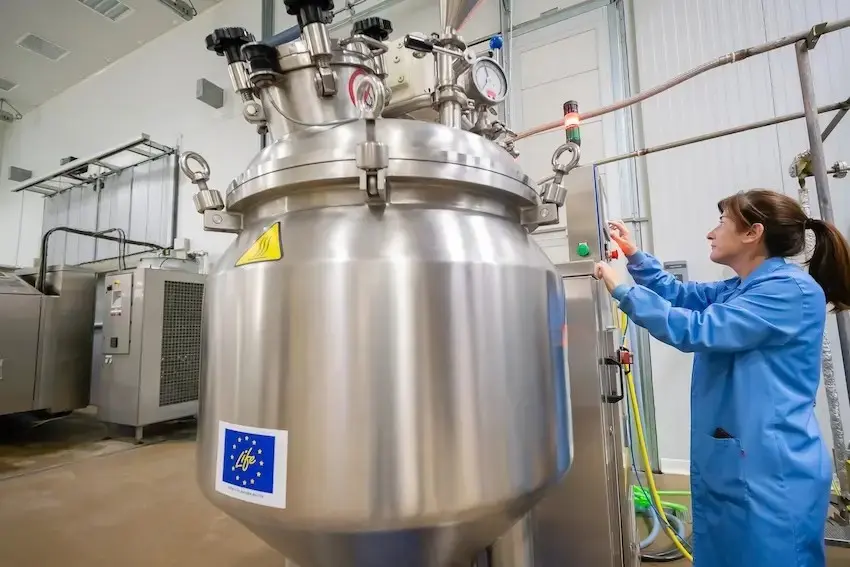
At AZTI, we combine biotechnology and molecular biology laboratories with processing facilities and a pilot plant at semi-industrial scale. This allows us to move progressively closer to the conditions a technology will encounter in a company.
We can test different configurations, identify critical points, calculate yields and check whether the product retains the properties observed at smaller scale.
This is when we start to see whether a technology has genuine industrial potential. We may achieve an excellent result in the laboratory, but if productivity, stability or competitiveness are lost as we scale up, there is still work to be done.
Our aim, therefore, is not simply to demonstrate that a biotechnology works. We want to know whether we can produce it safely and consistently, maintain its performance as we scale up, and do so at a cost that makes sense for industry.
When we can begin to answer these questions positively, we no longer have just a good research result. We have a technology with real potential to become an industrial solution.