News
Content index
From 13–15 May, the Food4Future 2025 summit became a vital forum for debate and reflection on the present and future of the food industry.
Fill out the form, and we’ll email you the download link.
jQuery("#descarga-azti-form > div > label > input[type=text],#descarga-azti-form > div > label > input[type=email]").on('change', function(){ if(jQuery(this).val() != '') { jQuery(this).parent().addClass("has-content"); } else { jQuery(this).parent().removeClass("has-content"); } });
const privacidad = document.getElementById("azti-acepto-privacidad"); const comunicaciones = document.getElementById("azti-acepto-comunicaciones"); const enviar = document.getElementById('azti-enviar'); if(privacidad.checked && comunicaciones.checked) enviar.removeAttribute("disabled", ""); privacidad.addEventListener("click", function (event) { if(privacidad.checked && comunicaciones.checked) enviar.removeAttribute("disabled", ""); else enviar.setAttribute("disabled", ""); }, false); comunicaciones.addEventListener("click", function (event) { if(privacidad.checked && comunicaciones.checked) enviar.removeAttribute("disabled", ""); else enviar.setAttribute("disabled", ""); }, false);
Below, we share some of the most compelling insights and ideas discussed over the three days.
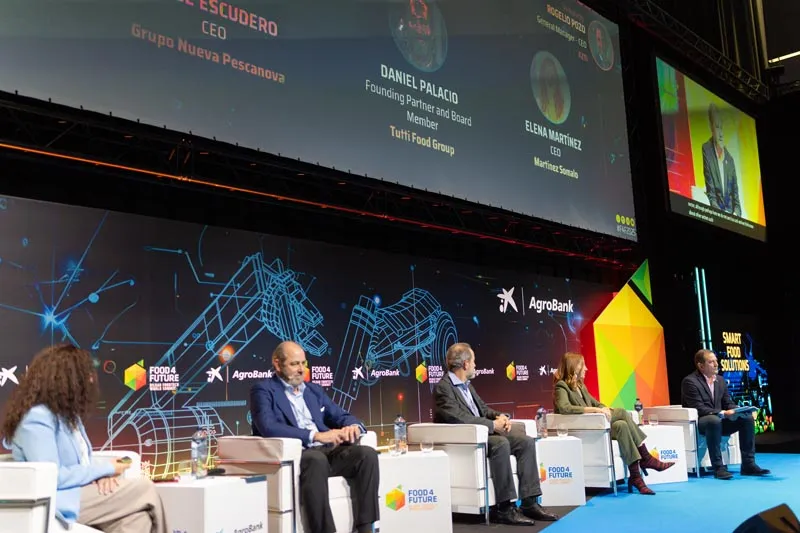
In two panel discussions titled “Challenges and Opportunities in the Food Industry”, the CEOs of Angulas Aguinaga (Oscar Vicente), McCain Foods (Pablo Palza), Delaviuda (Isabel Sanchez), Anecoop (Joan Mir), Eroski (Rosa Carabel), Nueva Pescanova (Jorge Escudero), Tutti Food Group (Daniel Palacio), and Martínez Somalo (Elena Martínez) agreed that the sector is undergoing a period of immense pressure and uncertainty. Inflation, mounting cost pressures, fragile supply chains, the dominance of private labels, growing environmental demands, workforce shortages, and shifting consumption patterns are reshaping the landscape. Today’s consumers want to cook less, eat better, and enjoy food that’s easy, quick, and tasty. Consumer behaviour has changed—and the planet isn’t waiting.
These discussions did not merely map the future of the food industry; they also identified the essential skills needed to lead it. The key lies in transforming uncertainty into a competitive advantage through strategic data integration, cross-sector collaboration, and constant innovation in both products and processes. Diversifying markets and business lines, alongside smart management to maximise operational efficiency and create value, is now imperative. In this context, young talent emerges as a critical asset, calling for clear strategies to attract, develop, and retain it—building diverse, cohesive teams ready to meet the demands of a global marketplace.
Sector leaders share a hard truth: feeding more people in a resource-constrained world demands radical transformation. The industry can no longer afford hesitation or sluggishness. To lead in this space is to understand that we’re playing by new rules—centred around three pillars: sustainability, agility, and humanity. The value chain must be boldly reimagined, preserving margins without compromising its core. In this environment, there’s no time for doubt—action is the only viable path for those seeking relevance.
The sector must now reinvent itself to stay competitive and profitable while lowering its environmental footprint. The key lies in meeting the expectations of an increasingly discerning consumer who demands healthier, functional, and accessible food. Now is the time to lead with bold vision and strategies that anticipate a constantly evolving market.
The paradox the industry faces is this: deliver affordable prices while generating sustainable value for shareholders, clients, and people. The equation is simple—affordable prices = extreme efficiency + accurate forecasting. But how does one achieve this in a volatile market? According to the CEOs, data management is no longer a supporting tool—it’s the lifeblood of the entire food chain. From sourcing raw materials to logistics, predictive algorithms can reduce waste by 30% and forecast demand with 90% accuracy.
The true revolution comes not from collecting data, but from sharing it strategically across suppliers, producers, and distributors. This collaborative approach creates a highly efficient ecosystem where transparency eliminates hidden inefficiencies and enhances the entire value chain—unlocking significant opportunities for all players.
Quotes to Remember:
In the face of demographic decline, there’s consensus on one urgent truth: people must be placed at the heart of the industry. Succession planning and talent retention are essential to attract new professionals and promote diversity, inclusion, and team cohesion. The sector must elevate its image to become more appealing—especially to younger professionals. We need young talent to view the agri-food industry as innovative, digital, and socially impactful.
Private label brands took centre stage in César Valencoso’s (Kantar Media) talk, “Private Label vs Manufacturer Brand: The Final Battle.” Valencoso highlighted the unstoppable rise of private labels in the consumer goods market, driven by large retailers and a diminishing perception of quality differences. This dominance creates a highly competitive environment for manufacturers.
The growing tension between private labels and manufacturer brands is now a critical issue. Many companies are shifting their focus back to growth (top line) after years of cost-cutting—a difficult task in a market increasingly dominated by retailers and their own brands. This battle is not just a trend but central to the future of branding.
Valencoso argued that manufacturers shouldn’t focus solely on price competition. Instead, he advised a long-term strategy based on brand investment, innovation, and quality. Fear must not be allowed to paralyse decision-making. There’s still room for growth—perceived value, innovation, and emotional connection can all outweigh price.
Innovation is therefore essential to building authentic, powerful brands that resonate emotionally with consumers. More—and better—research is needed to understand new consumer behaviours and motivations in this evolving context.
In an increasingly fragmented and competitive market, brands must expand globally without losing their local identity. This tension was central to the panel discussion “Local Brands vs Global Brands vs Private Labels”, featuring Javier Roza (Mantequerías Arias), Carmen Guelbenzu (Eroski), Iratxe Berriozabal (Angulas Aguinaga), and Néstor Nava (Grupo Gallo).
Topics included positioning, consumer loyalty, and how to build competitive advantage through unwavering quality, local authenticity, and constant innovation—the latter defined as the ability to adapt swiftly to evolving consumer and retail demands.
In light of private label growth, the challenge is not just to compete but to collaborate with retailers to better serve diverse consumer profiles and maintain a dynamic innovation ecosystem.
For manufacturers, the key to standing out lies in the “triangle of differentiation”: a unique product (superior and perceived as such), a recognised brand, and the ability to deliver added value (and higher margins). One standout example is Le Rustique Camembert, launched in 2024 and, within ten months, becoming category leader with double-digit growth and capturing 70% share over private labels—despite a higher price point. This case shows that success is possible when the value proposition is clear and distinctive—an inspiring example of a brand revitalising its category and creating value across the chain, from distributors to consumers.
Key Takeaways:
In conclusion, the current environment demands adaptability, consumer focus, and bold decisions. There is no single winning model—each type of brand has its own levers for success. But one thing is clear: consistency between what a brand says, does, and stands for will matter more than ever.
Finally, Food4Future also addressed a core challenge for the industry: attracting and retaining talent.
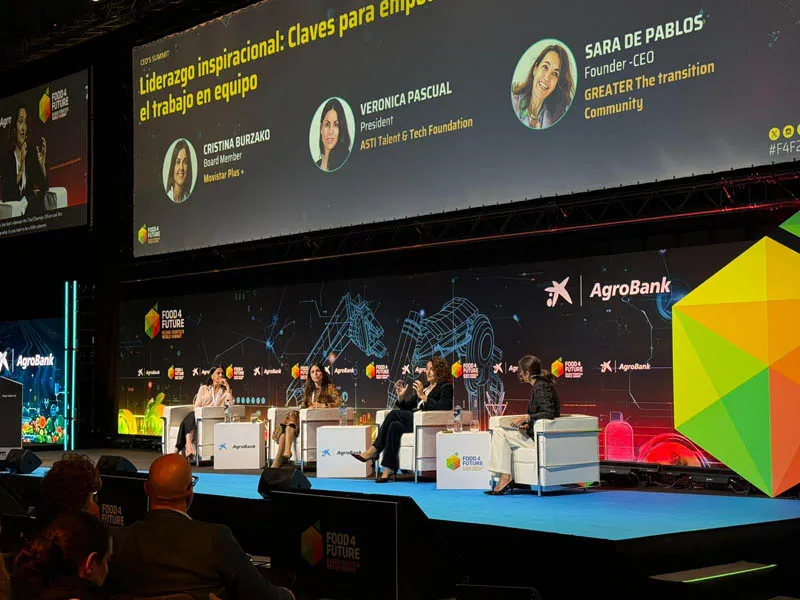
In the session “Inspirational Leadership: Empowering People and Fostering Teamwork”, business leaders from tech and agri-food—Cristina Burzako (Telefónica), Verónica Pascual (Asti Foundation), and Sara De Pablos (Greater Transition Community)—shared insights and reflections.
They stressed the need to dignify and elevate careers within the agri-food sector to position it as an appealing and professionally rewarding field. The discussion highlighted key HR issues: diversity, inclusion, average workforce age, absenteeism, and hiring challenges in the agri sector. All agreed on one essential ingredient for success in today’s climate: people. Talented, motivated, empowered individuals who align with the company’s purpose and values.
To attract and retain talent that adds value and fosters teamwork, companies must understand the new expectations and values of today’s professionals. The speakers called for a more soulful leadership style—one that inspires and empowers. They also stressed the importance of building united teams around a shared mission and maintaining transparent, consistent communication to align the business with its purpose and build strong, attractive employer brands.