The increasing frequency of accidents and emergencies at sea is one of the main reasons for having an operational oceanographic system that provides valuable information for managing marine pollution. A need that was recently reminded by the plastic pellets that entered the sea after the sinking of the ship Toconao in Portuguese waters at the end of 2023.
But apart from one-off accidents, we must not forget the problem of marine litter and, more specifically, the presence of plastic objects in the sea, an increasingly worrying environmental issue.
The identification of potential accumulation areas and the ability to predict the behaviour of marine litter are essential for the development of measures which will help to measure and manage the impact of marine litter.
To address this issue, we need to better understand the role that ocean motion plays in the dispersal and accumulation of marine plastics, both microplastics (<5 mm, which would include pellets) and larger objects such as meso- (5 mm-2.5 cm) and macro-litter (>2.5 cm), both at the surface and in the water column, as well as on the seabed.
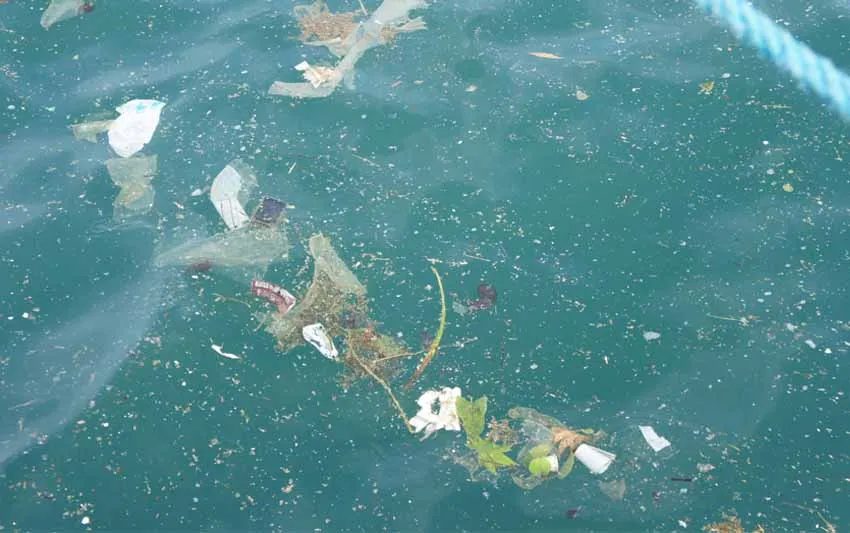
Floating marine litter
Understanding marine litter behaviour through observation
At AZTI, we characterise marine litter and microplastic accumulation in the ocean through in situ and ad hoc sampling, and seek to understand the processes involved in their movement through direct observation.
To achieve this, we collect samples at the surface and at different depths in the water column, covering a wide range of particle sizes, to help determine the spatial and temporal distribution of marine litter. Knowing this distribution is key to validating numerical models that allow us to predict the behaviour of marine litter, both at the surface and along the water column.
In situ sampling also allows us to analyse and provide observational evidence for the composition, spatial distribution, abundance, life cycle, origin and physical factors and processes that determine the accumulation of litter in the sea.
What are the marine litter monitoring campaigns?
We use a variety of observation methods, from visual sightings or observations of litter accumulation on the sea surface, to sampling for micro-, meso- and macro-plastics using trawls, to launching drifting floats and using high-frequency radar data to study ocean currents.
As for the process and recording of sampling, these are the steps:
Observing the physical processes behind the accumulation of marine litter using a combination of platforms, such as drifting floats launched during a field survey, high-frequency radar and other remote monitoring techniques.
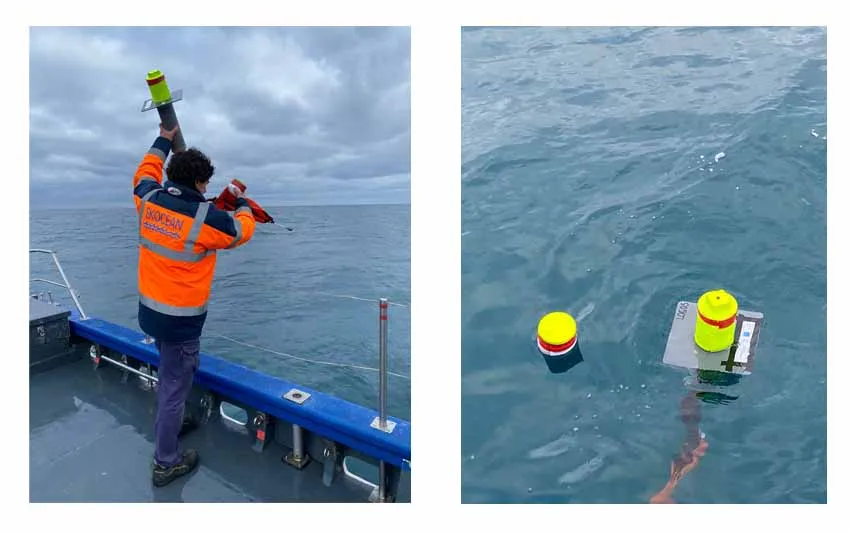
Collection and analysis of data from drifting floats. Once an area of marine litter accumulation has been identified, surface floats are deployed at nearby positions in the area or along the line of litter concentration. This allows the 2D geometry of the surface litter and the variability of currents in the accumulation zones to be studied, as well as the lifetime and fate of the litter.
Observaciones operativas de procesos físicos clave. Esta fase se hace mediante radares de alta frecuencia de observatorios como EusKOOs (el sistema de oceanografía operacional que operamos para el servicio vasco de meteorología, Euskalmet), con los que se recuperan parámetros clave de los procesos oceánicos superficiales. A través de otros sistemas como imágenes satelitales o videometría de alta resolución, también se pueden detectar acumulaciones en zonas frontales a lo largo de la costa.
Operational observations of the main physical processes. This phase is carried out using high-frequency radars from observatories such as EusKOOs (the operational oceanographic system we operate for the Basque Meteorological Service, Euskalmet), which provide key parameters of surface ocean processes. Other systems, such as satellite imagery or high-resolution videometry, can also be used to detect accumulations in frontal areas along the coast.
LAMARCA: Lagrangian transport of marine litter and microplastics in coastal waters
Much of this work is represented by the LAMARCA project, which began in 2022 and is funded by the Ministry of Science and Innovation and its “Proyectos de Generación del Conocimiento” programme of the National Plan for Scientific and Technical Research and Innovation, as well as European ERDF funds. LAMARCA focuses on two study areas that are highly affected by the accumulation of marine litter: the Bay of Biscay and the Western Mediterranean.
The project focuses on the study of ocean currents and their impact on transport, with oceanographic campaigns, models and novel Lagrangian tools (an approach that takes into account the motion of individual particles as they move with the fluid) based on complex systems.
LAMARCA aims to characterise marine connectivity and mixing properties in coastal waters, and to understand the different spatial scales and connectivity structures that would favour the dispersal or accumulation of marine litter in the coastal zone. To this end, it presents an innovative methodology that combines the expertise of three research groups with extensive experience in their respective fields:
Numerical modelling at very high resolution (Imedea)
Development and application of complex systems Lagrangian analysis tools. (IFISC)
Monitoring and data collection of marine litter in the different environmental spheres, through in situ sampling. (AZTI)
The data collection carried out by AZTI, to which other data from satellites, fixed stations and international databases can be added, will help to validate the models used to study the processes and carry out Lagrangian simulations.
What have we achieved so far?
The results so far show how phenomena such as small-scale fronts and eddies are crucial to the distribution of litter in the sea. These structures are formed by various phenomena such as winds, tides or changes in water density, and cause floating marine litter to become trapped in these areas or confluence zones.
These confluence zones attract not only marine debris, but also larvae, algae and organic matter, which increase biological activity and facilitate the interaction between plastics and marine life. Understanding these areas is therefore fundamental to understanding how plastics affect marine life, including megafauna.
Although work on the LAMARCA project has its own timetable, the initial results have been useful in the context of the crisis caused by the Toconao spill, for example by developing operational simulations for pellet monitoring in record time.
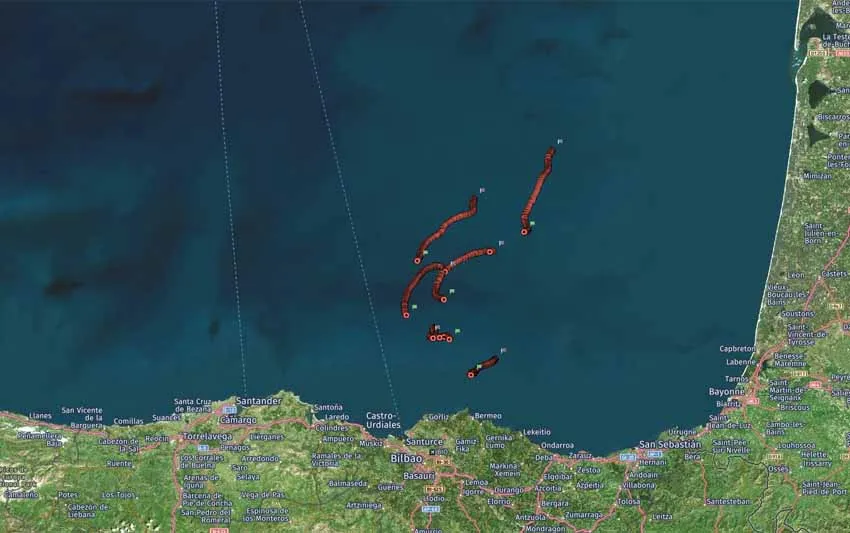
Drifting floats launched off the coast of Bermeo on 12 January 2024. The real data obtained from the floats allow a real comparison with the simulation results, as well as the study of the differences in behaviour in the case of an oil spill with or without direct wind resistance.