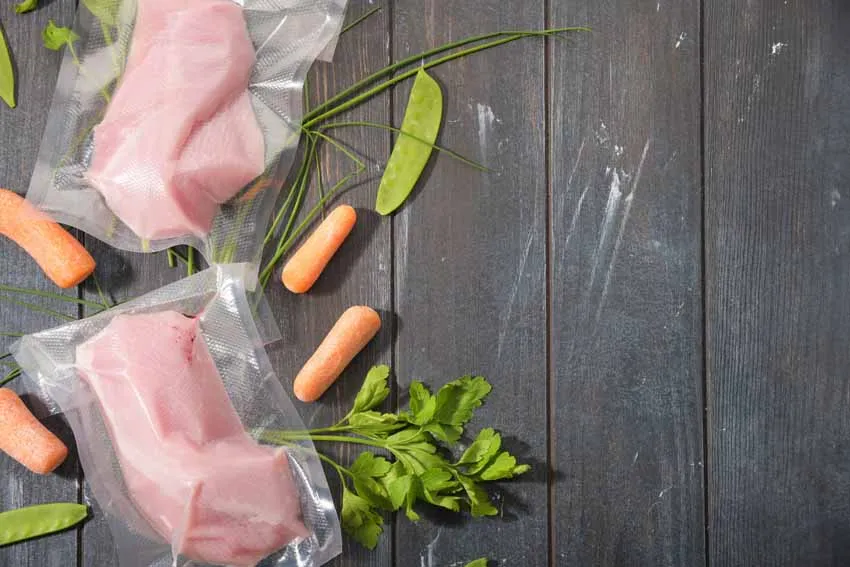
The sous vide technique is an innovative cooking method that combines vacuum packaging with cooking at controlled and relatively low temperatures (<80 °C). This technique is characterised by immersing food sealed in airtight bags in a water bath at a precise temperature, which improves flavour, texture and nutrient retention, retains juices and provides more even heat distribution. However, low temperatures pose challenges to ensure effective elimination of dangerous micro-organisms.
AZTI’s Food Quality, Integrity and Safety area has recently carried out a study on the implications of using this technique in products made with chicken or eggs, common sources of dangerous pathogens such as Salmonella, Campylobacter and Clostridium spores. Clostridia are anaerobic bacteria, which means that they only grow in the absence of oxygen. In addition, they have the ability to generate spores, forms resistant to adverse conditions, which are highly resistant to heat.
This analysis, published in the journal Foods, provides key data to adjust critical time and temperature parameters, helping to prevent microbiological risks, strengthen consumer confidence and ensure safe practices in the food and catering industry.
Main findings:
1. Inactivation of pathogens:
- Treatment of chicken at 60°C for 40 minutes is sufficient to reduce the presence of Campylobacter coli and Campylobacter jejuni by at least 5 orders of magnitude, eliminating them completely.
- Treatment of eggs at 70°C for 5 minutes is sufficient to reduce the presence of Salmonella enterica by at least 4 orders of magnitude, although it does not eliminate it completely.
- Treatment of chicken at 60°C for 40 minutes is sufficient to reduce the presence of natural aerobic flora by at least 3 orders of magnitude, but not to eliminate it completely.
- Treatment of chicken at 60°C for 40 minutes is not sufficient to destroy Clostridium spores.
2. Critical factors:
- Cooking temperatures of 60-70°C, as used in sous vide, significantly reduce the levels of micro-organisms present in the food, although they are not sufficient to eliminate them completely, especially micro-organisms that can develop spores.
- The combination of time, temperature and storage is therefore key to ensuring microbiological safety. Rapid cooling after cooking is essential to maintain safety.
3. Cooling and storage:
- Vacuum storage, i.e. in the cooking bag itself, under refrigerated conditions (6°C) for 14 days of treated chicken will not result in the proliferation of Clostridium spores or natural flora.
- Vacuum storage of treated eggs under refrigerated conditions (6°C) for 7 days does not result in the multiplication of Salmonella enterica.
- Storage below 6°C is essential to maintain the microbiological safety of the food.
4. Impact of ingredients::
- Although, according to the bibliography, certain seasonings (onion, garlic, spices, etc.) can alter the effectiveness of heat treatment, in our study we did not find any differences between seasoned and unseasoned products.
Implications for the foodservice industry
- Personalised control: It is essential to adapt temperatures and times to each type of food, although temperatures should always be above 60ºC.
- Safe storage: Adequate refrigeration conditions must be ensured, below 6ºC if the products are not to be consumed immediately. This temperature should be reached as soon as possible after cooking.
- Safe consumption: It is also important to determine the consumption time, i.e. the time the food can remain stable at room temperature, i.e. without proliferation of micro-organisms that have survived cooking. Although not determined in this study, it is known that this time is very limited, between 4 and 6 hours, depending on the ambient temperature. In other words, safe practice dictates that food should be removed from the refrigerator and consumed almost immediately.
- Regulations and training: It is necessary to train staff in the safe use of the sous vide technique to avoid microbiological risks.