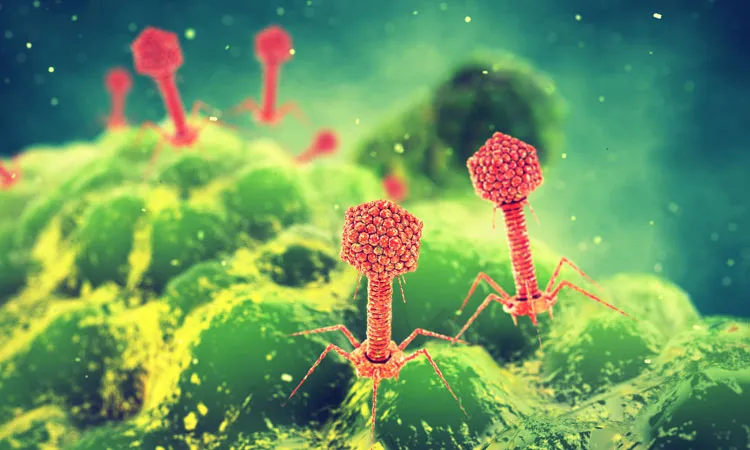
AZTI research centre is investigating the possibility of using antibacterial viruses to prevent food-borne diseases. One of the greatest advantages is that these viruses only affect one bacterial species or genus and are not harmful to other beneficial bacteria, animals or plants.
Although when we hear the word virus, disease and misfortune come to mind, viruses are not always enemies. For example, phages could be important allies for our health.
Bacteriophages, or phages, infect bacteria, so it is easy to see why they are interesting as humans. For example, we can use them to fight infection when antibiotics don’t work or to prevent food poisoning.
It is precisely in this second area that research is being carried out at the AZTI research centre of the BRTA alliance. They develop tools to control pathogens that are spread through food. And, among other things, research is being carried out with phages for this purpose. Precisely because they can provide new solutions against food-borne pathogens, research on phages in food safety has intensified in recent years.
The first step is to find phages of interest. To do this, they explore and take samples from the places where the bacteria they infect grow: water, soil, sea, foodstuffs, and so on.
AZTI researchers especially characterise and analyse phages that attack three bacterial genera: Campylobacter, Vibrio and Listeria. In fact, the bacteria of these three genera have a great impact on our health and in some cases can cause serious problems.
In the lab, they proliferate and purify the phages in order to complete the phage collections that will fight the diseases. They also study them genetically to make sure they are only working with phages that kill bacteria of interest.
They envisage that it will be possible to use phage-based strategies throughout the agri-food chain, both in the primary sector and during food processing (through direct application to food and/or food contact surfaces). The aim would be to control pathogens that may cause problems and to ensure safety of the food we eat.
On the other hand, phage-based strategies are only regulated and approved in a few countries in the world. Not yet in Europe. However, researchers see this possibility as close. In fact, it is clear to them that the use of viruses that infect bacteria could be very interesting for tackling various health problems.
‘We like to say that they are good viruses because they only infect bacteria and are absolutely harmless to animals, plants and humans,’ says Lasagabaster. ‘The use of phages will be a future strategy to combat many problematic bacteria. They will be a very powerful alternative, for example, to fight antibiotic resistance, or to combat food-borne diseases”.