The Basque Operational Oceanography Research Infrastructure (EuskOOS-RI) is a leading reference for monitoring and managing coastal marine ecosystems in the Basque Country. This multidisciplinary, multi-platform system is designed to integrate, coordinate, and strengthen marine observation, monitoring, and modelling capabilities along the Basque coast of the Bay of Biscay. Providing reliable data is essential for research, management, and strategic decision-making in marine environments.
EuskOOS-RI brings together all the capabilities of the EuskOOS Operational Oceanography system, jointly operated by Euskalmet and AZTI, and connects them to an advanced network of observing platforms—meteo-oceanographic buoys, high-frequency radars, coastal stations, tide gauges, coastal video monitoring, and gliders. These platforms generate data that feed high-resolution forecasting tools, supporting both marine management and scientific research.
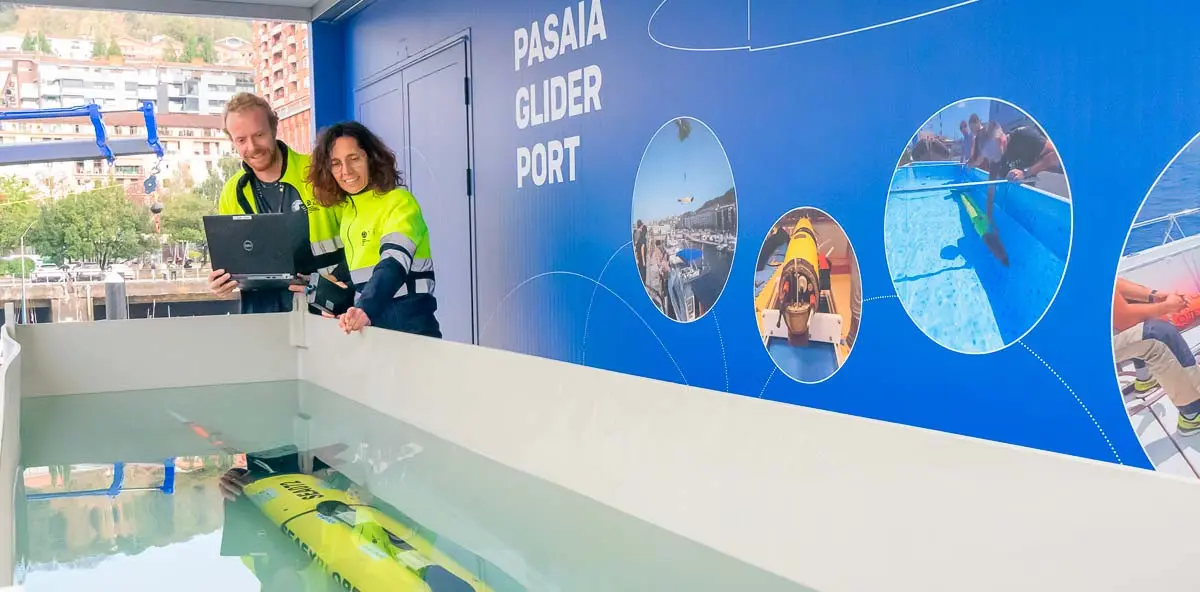
One of EuskOOS-RI’s most innovative components is POA (Pasaia Ocean Autonomy). From Pasaia, AZTI operates Spain’s pioneering infrastructure for deploying and managing Marine Autonomous Systems (MAS)—including gliders, marine drones (Itsasdrone), and unmanned surface vehicles such as Ranger 6.0. These platforms can collect high-resolution data in hard-to-reach areas, reducing costs and risks compared to traditional oceanographic campaigns. With POA, the Basque Country is positioning itself as a key hub for emerging marine observation technologies, supporting sustainable coastal management and helping address regional challenges such as climate change, the blue economy, and ecosystem resilience.
Technology serving marine knowledge
With its operational centre located in the port of Pasaia (PasaiaPort, Gipuzkoa), EuskOOS-RI relies on a port-based infrastructure that supports the deployment and maintenance of oceanographic platforms. This logistical setting enables efficient operation of a high-tech observing network across the entire Basque coastline and the Bay of Biscay, while also providing scientific advice and technical support for field campaigns, sensor integration, and model validation—strengthening collaboration among research centres, public administrations, and the private sector.
Platforms operated within EuskOOS-RI include:
-
Meteorological and coastal stations, tide gauges, and instrumented buoys.
-
High-frequency radars and coastal video monitoring stations.
-
Remotely operated vehicles (ROVs), autonomous surface vehicles (ASVs), autonomous underwater vehicles (AUVs), and autonomous seabed “lander” platforms.
-
Oceanographic instrumentation (multiparameter probes, current meters, profilers, etc.).
Open and accessible data to boost marine research
A core pillar of EuskOOS-RI is its commitment to open access. The platform provides the scientific, technical, and educational communities with real-time information and validated historical time series, enabling a wide range of applications:
-
Water quality and coastal dynamics studies.
-
Forecasting natural hazards and extreme events.
-
Designing environmental policies and climate adaptation strategies.
-
Marine science education and outreach.
This accessibility makes EuskOOS-RI an essential tool for researchers, environmental managers, marine resource authorities, and maritime professionals.
EuskOOS-RI is also one of the components of ebegi, the “super-observatory” that aims to integrate the full range of multidisciplinary marine observation efforts carried out by AZTI and its partners in the southeastern Bay of Biscay.
This interoperable network is connected to European systems such as Copernicus, EMODnet, EuroGOOS, and JERICO-RI, enabling smooth data exchange and fostering international collaborative science.
A multidisciplinary team for comprehensive observation
EuskOOS-RI operations are supported by a highly specialised technical and scientific team. Their combined work ensures the quality and usefulness of the collected data, while also driving innovation in marine observation and analysis methods:
Instrumentation technicians: deployment and maintenance of sensors and platforms.
- Field samplers: collection of physical, chemical, and biological data.
- Modellers and data analysts: numerical model development, validation, and scientific product generation.
- Interoperability experts: integration into open platforms and alignment with international standards.
- Marine researchers: development of collaborative projects and knowledge transfer to society and industry.
Predictive capability is another major added value of EuskOOS-RI. The system includes a suite of numerical models to simulate marine dynamics and anticipate different scenarios:
- 3D hydrodynamic models (ROMS, MOHID, DELFT3D): simulate currents, temperature, salinity, and contaminant transport.
- Wave models (WAM, SWAN): simulate wave height, direction, and energy in offshore and coastal waters.
- Morphodynamic models (XBEACH): analyse how beaches, dunes, and seabeds evolve during extreme events.
In addition, Lagrangian post-processing tools are used to simulate particle trajectories (e.g., drifting objects, eggs and larvae, microalgae, contaminants, or microplastics), improving the study of physical and ecological connectivity and water mass drift.
Digitalising the marine environment is another area where EuskOOS-RI stands out. Through ocean digital twins, it is possible to build virtual replicas of the Basque coastline that combine real observations with advanced modelling. This makes it possible to:
- Assess climate change impacts.
- Simulate future marine scenarios.
- Design nature-based solutions for sustainable coastal management.
- These tools are complemented by open data management and visualisation platforms that allow users to download, analyse, and share information in an intuitive way.
Institutional collaboration and contribution to the blue economy
EuskOOS-RI is strategically aligned with public policies and institutional cooperation frameworks in the Basque Country. It maintains active collaborations with organisations such as Euskalmet, IHOBE, NaturKlima, the University of the Basque Country (EHU), KOSTARISK, and other entities within the Basque science and technology system.
Within this framework, it provides technical and scientific support for:
- Early warning systems and forecasting of extreme weather events.
- Civil protection planning and natural risk prevention.
- Design and monitoring of environmental and climate policies.
Internationally, its integration into European networks strengthens the global visibility of Basque marine science and contributes to shared solutions for ocean-related challenges.
Finally, EuskOOS-RI also promotes social innovation and the blue economy by encouraging dialogue between science, citizens, businesses, and institutions—supporting inclusive and responsible marine management.
The coastal observing network of the EuskOOS Operational Oceanography system is funded by the Directorate for Emergency Attention and Meteorology of the Basque Government’s Department of Security. A transformative 2022–2024 project under the “Technological and Industrial Hub for the Development of the Blue Economy in Oarsoaldea”, funded by the Deputy Ministry of Agriculture, Fisheries and Food Policies of the Basque Government with Berpiztu funds, has enabled the development of innovative ocean observation services through public–private collaboration.
In addition, the implementation of EuskOOS-RI has been further strengthened through financial support from the Department of Economic Promotion and Strategic Projects of the Provincial Council of Gipuzkoa, within the 2025 Support Programme for the Gipuzkoa Network of Science, Technology and Innovation. This funding has equipped the infrastructure with advanced technologies and systems needed to consolidate its marine observation and forecasting capacity from the port of Pasaia, through the investment projects “Autonomous Underwater Vehicle (glider) for multidisciplinary ocean observations” (2023 call) and “Advanced systems for the EuskOOS-RI coastal observing research infrastructure in Pasaia” (2025 call).